Trained as a young classical violinist to revere written scores as “doctrine,” Ariana Kim experienced another side of music every summer at bluegrass fiddle camp in Idaho.
“That was my first introduction to improvisation,” said Kim, a Grammy Award-nominated performer and associate professor of music in the College of Arts and Sciences (A&S). “What happens if someone takes a solo on this eight-bar phrase? What if someone else takes a solo in a different key? That whetted my appetite.”
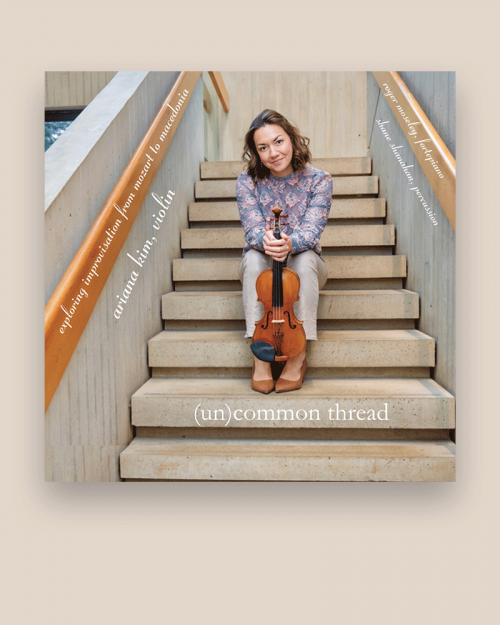
Kim indulges that appetite for musical embellishment, flexibility and spontaneity in her new album, “(un)common thread,” which will be released from Saffron Soul Records May 26. The improvisational album ranges from early Beethoven recorded on historical instruments to Indian raga to an original duet for violin and looper pedal.
At an album drop “listening party” May 3 at 7 p.m. in the Hans Bethe House Common Room on West Campus, Kim will perform live two solo pieces she composed for the album, followed by a listen to the album in its entirety. The listen-through will be interactive; audience members who read music can look at printed scores to compare against variations in the recording, and those who don’t can keep track on a score card of how many embellishments and improvised solos they hear.
“It should be a fun game,” Kim said. Pre-sale CDs and preorder download cards will be available at the event, too.
“(un)common thread” explores improvisation through two seemingly disparate lenses: 18th century violin sonatas with fortepiano, and world folk music with percussion.
The album’s “A side” features 18th century violin sonatas by Mozart and Beethoven, “two of the greatest original improvisors,” Kim said, collaborating on these pieces with Roger Moseley, associate professor of music (A&S) on fortepiano. Kim and Moseley recorded the works on historical instruments: an 18th-century violin wound with gut strings and a Schantz replica fortepiano built by Thomas and Barbara Wolf courtesy of Malcolm Bilson, the Frederick J. Whiton Professor of Music Emeritus (A&S), and the Cornell Center for Historical Keyboards, where Moseley is the director.
After a bridge piece of classical South Indian music, an aalapana (or improvisation) on the raga “Bahudari” arranged by Kim, the “B side” features original compositions by Kim and percussionist Shane Shanahan, as well as arrangements of folk music from Bulgaria and Macedonia.
A founding member of Yo-Yo Ma’s Silk Road ensemble, Shanahan is a Grammy Award winner himself. He and Kim met back in 2013 doing a project with The Knights, an orchestral collaborative centered on improvisation, when Kim was struck by the way he thought about music and his sense of pulse and freedom.
Improvisation is the thread that sews the album together, Kim said; the unlikely collection of pieces gives the collection its uncommon character.
“I wanted to bring listeners into my brain to hear how beautiful improvisation and freedom and spontaneity in music can be,” Kim said. “Once you have a framework, there are so many possibilities.”
Kim’s early interest in improvisation followed her to the Juilliard School, where she played with an improvisation ensemble and explored, in her dissertation, improvisation in jazz. These endeavors in turn led her to world music traditions that incorporate the same elements. She studied in South Korea and recently spent six months in southern India learning Carnatic music, a journey documented by PBS NewsHour.
“I find that when I improvise on a Carnatic raga, it opens a new pathway in my brain for Bach,” Kim said. “When I improvise in Bach, it makes me think differently about harmonic structure in a bluegrass tune. And when I improvise on a bluegrass tune, it makes me think differently about Korean music.”
Improvising takes vulnerability and courage, Kim said. She asks her students who are playing classical concertos to come up with their own cadenzas – portions that call for extended improvisations for the soloist – but she encourages them to take it one step at a time and experiment in different styles. She hopes “(un)common thread” imparts some of what she tells her students: “Be brave, have fun, and don’t take it too seriously.”
Read the story in the Cornell Chronicle.
More News from A&S


After a devastating disaster, Nepal faces the challenge of giving it a name
Anthropology