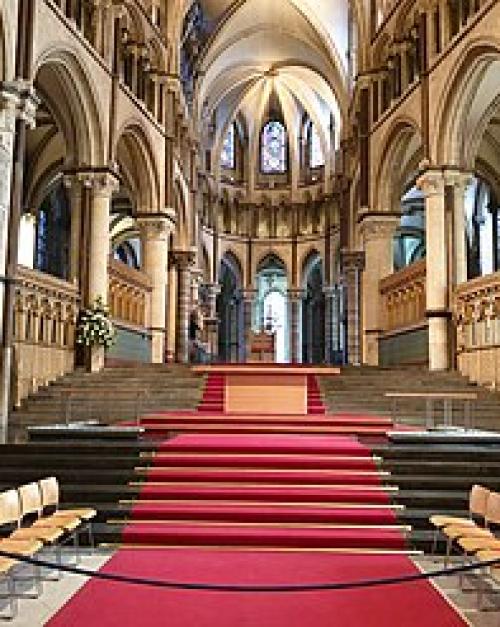
Sarah Mullally will be installed on March 25 as the 106th Archbishop of Canterbury. She is the first woman to hold the role in the Church of England’s nearly 500 year history, and her appointment last October drew criticism from conservative corners of the Anglican Communion.
Landon Schnabel, an associate professor of sociology at Cornell University who studies religion and social change, says that while the headlines will focus on the obvious, Mullally being the first woman in the role, the more interesting story is how she got there so fast.
Schnabel says:
“The Church of England ordained its first women as priests in 1994. It consecrated its first women as bishops in 2015. Eleven years later, a woman leads the whole institution. From the inside, thirty-two years may not feel fast. But for a traditional institution that traces its origins back centuries, fundamental change measured in decades rather than generations is noteworthy. The Catholic Church has declared the question of women's ordination permanently closed. The Southern Baptists moved backward, formally restricting the pastorate to men in 2000. Most Orthodox churches haven't budged.
"So why did Anglicanism move so quickly? Because each step built a constituency for the next one. Women priests became women in senior parish roles, which became women bishops, which made a woman archbishop not radical but expected. Each step also demonstrated that what skeptics feared didn't materialize. The church didn't fracture when women were ordained. Parishes didn't empty when women became bishops. When people can see a change working in practice, resistance loses its grip. The Church of England didn't leap. It built a ratchet.
“Mullally's appointment matters beyond Anglicanism because it tests a question every major religious tradition is facing in some form: whether institutions built by and for men can open their highest offices to women without fracturing in the process. The Church of England's answer is yes. Much of Christianity, and religion more broadly, disagrees.”
More News from A&S

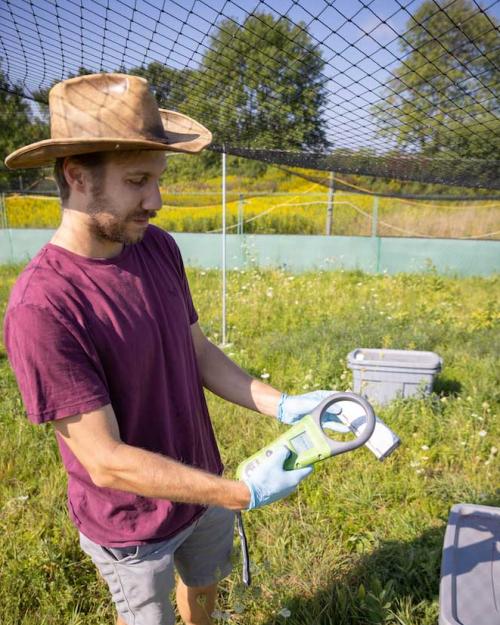
Cornell biologist named Blavatnik Award finalist for work with rewilded mice
Neurobiology and behavior
Cornell mathematicians win grants to ensure AI safety, research integrity
Mathematics