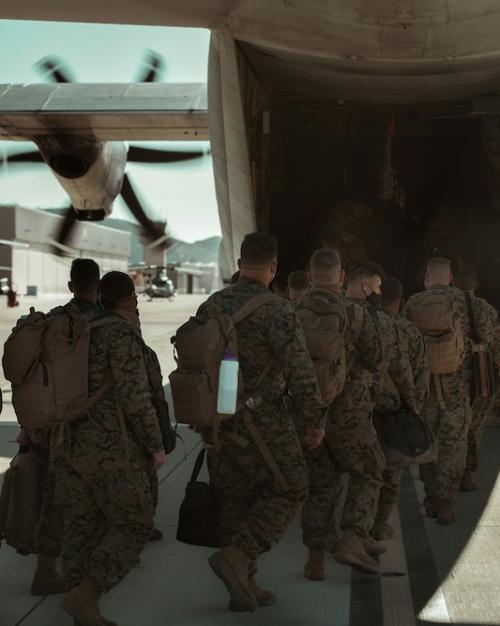
The Military Religious Freedom Foundation reports receiving more than 100 complaints from U.S. service members alleging that some commanders have framed current military operations in Iran in terms of Christian end-times prophecy, namely God’s plan for Armageddon and the imminent return of Jesus.
Landon Schnabel, associate professor of sociology at Cornell University who studies religion and social change, says that the use of such apocalyptic language by commanders reflects a climate shaped from the top down.
Schnabel says: “Tens of millions of American evangelicals hold some version of dispensational premillennialism — the belief that conflict in the Middle East will trigger Christ's return. This is a well-documented strand of American religion, not a fringe view.
"Individuals have a right to their beliefs. But there is a difference between believing this in your heart or hearing it at a church you choose to attend versus hearing it from your commanding officer at a combat readiness briefing.
“Over 110 service members across every branch and more than 30 installations have reported commanders framing the Iran war as fulfillment of biblical prophecy. That pattern is consistent with what we've seen at the top of the Defense Department: prayer services at the Pentagon, affiliation with pastors who advocate Christian theocracy, a Bible study that preaches divine obligation to support Israel. End-times theology didn't infiltrate the military. It was invited in.
“Religious freedom is a bedrock American value. It protects the individual's right to believe and practice, not the institution's right to tell individuals what to believe. Religious freedom guarantees every service member the right to their own beliefs. It does not give a commander the right to frame a war as God's plan in an official briefing. The Constitution and the Uniform Code of Military Justice (UCMJ) exist precisely to draw that line — to ensure the most powerful military in the world serves a broad republic, not a singular theology.”
---
Kim Haines-Eitzen, professor of ancient Mediterranean religions at Cornell who studies apocalyptic imagery in early Christian texts, says the belief that Christians should actively bring about the end times rests on a misreading of the Book of Revelation.
Haines-Eitzen says: “The Book of Revelation was written during a time of crisis in the first century and its message was one of hope – hope for a coming transformation of the earth. The word ‘Armageddon’ appears only once in the Bible, in Revelation 16:16, where Armageddon – likely a phonetic rendering of the Hebrew Har Megiddo, or Mount Megiddo – is named as the site where ‘the kings of the whole world,’ gathered by ‘demonic spirits,’ will be assembled for a final battle.
“Early Christians were deeply suspicious of Revelation’s vivid symbolism and sensational visions, precisely because they could be misinterpreted and lead to dangerous outcomes, including political violence.
“The idea that Christians can hasten the second coming of Christ through military might is a relatively new one, extending back to the apocalyptic fervor of the 16th-century Protestant Reformation.”
More News from A&S