Provided
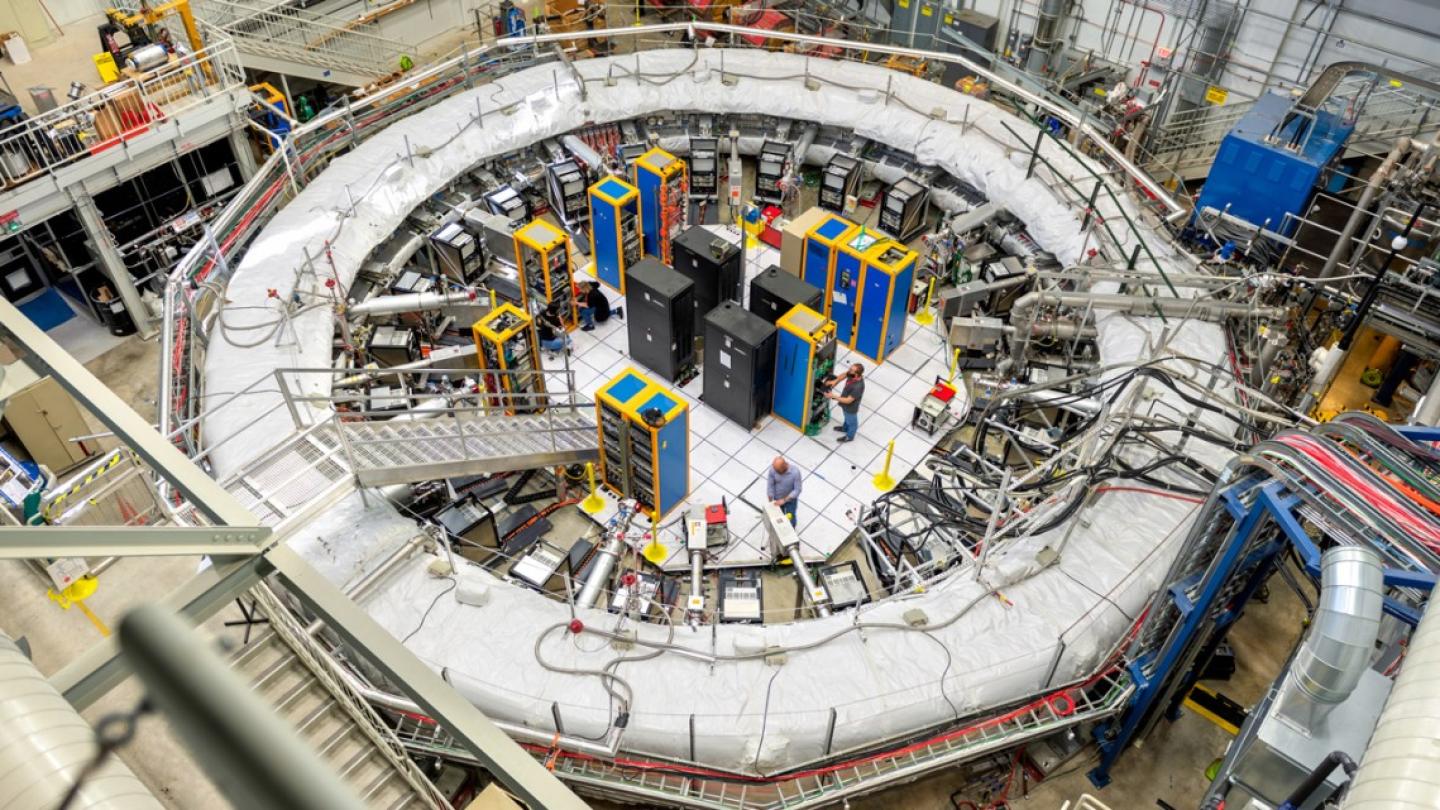
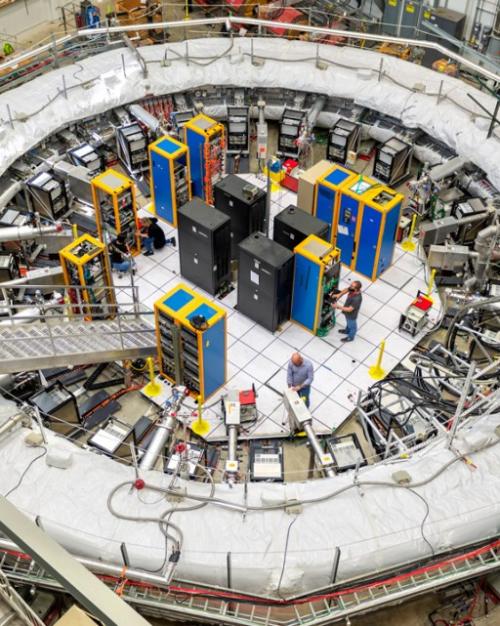
The muon g-2 ring sits in its detector hall amidst electronics racks, the muon beamline and other equipment at the Fermi National Accelerator Laboratory.
From theory to experiment: CLASSE contributions recognized in 2026 Breakthrough Prize in Fundamental Physics
Researchers and technical staff from the Cornell Laboratory for Accelerator-based Sciences & Education, CLASSE, played key roles in the international muon g-2 collaborations that were awarded the 2026 Breakthrough Prize in Fundamental Physics.
The prize recognizes decades of work across experiments at CERN, Brookhaven National Laboratory, and Fermi National Accelerator Laboratory to precisely measure the anomalous magnetic moment of the muon, a quantity that provides one of the most sensitive tests of the Standard Model of particle physics.
Among those recognized is Cornell physicist Lawrence Gibbons, whose group at Cornell and CLASSE contributed to detector systems, electronics, firmware, beam instrumentation, and data analysis that enabled the experiment’s extraordinary precision.
“It was really gratifying to have the experiment recognized,” Gibbons said. “These small, high-precision experiments sometimes get lost in the shuffle compared to the very large collider experiments. But they open windows in very different ways into what else could be out there.”
Simon Wheeler, Cornell University
Cornell Provost Kavita Bala speaking with Kalaniyot Sabbatical Scholar Naomi Havron at the Kalaniyot reception Oct. 19. In the background, Kalaniyot Fellow Eden Eran Nagar speaks with Fellow Shachar Yerushalmi.
Ryan Young/Cornell University
Seidenberger built Hopper from scratch so students can see the logic on which it is built and play a role in developing it and improving it over the course of his class.
Provided
The muon g-2 ring sits in its detector hall amidst electronics racks, the muon beamline and other equipment at the Fermi National Accelerator Laboratory.