Lawrence Gibbons, professor of physics in the College of Arts and Sciences, is among the researchers awarded the 2026 Breakthrough Prize in Fundamental Physics for the muon g-2 collaborations at CERN, Brookhaven National Laboratory and the U.S. Department of Energy’s Fermi National Accelerator Laboratory.
Gibbons, a Fermilab collaborator, studies precision measurements of fundamental parameters in particle physics. His leadership was key to pinpointing a measurement of a particle called the muon, which could have big implications for understanding the subatomic world.
The award, announced April 18, came as a total surprise, Gibbons said.
“I am proud of the major roles that our Cornell group played in the measurement. Our success was possible because of the amazing Cornell students and postdocs,” he said. “The award underscores the importance of smaller, high-precision measurements in our exploration of particles and the search for the origin of dark matter.”
The muon is a heavy, unstable cousin of the electron and can behave like a tiny magnet. For more than six decades, scientists and engineers from the three collaborating organizations have pursued extreme precision in experiments seeking an important number – the anomalous magnetic moment of the muon.
Prior work has shown that muons’ magnetic field deviates significantly from the Standard Model, which is used to explain the laws that govern fundamental particles.
The collaboration sought to capture how the muon’s magnetic strength is subtly affected by the “foam” of virtual particles constantly popping in and out of empty space around it. Measuring the muon’s magnetism and comparing it to theoretical predictions enabled physicists to test whether any unknown particles or forces are hidden in this foam.
This endeavor required extreme precision; in 2025, the collaboration announced data collected between 2021 and 2023 had increased the precision of their measurements by more than a factor of four, to 127 parts-per-billion.
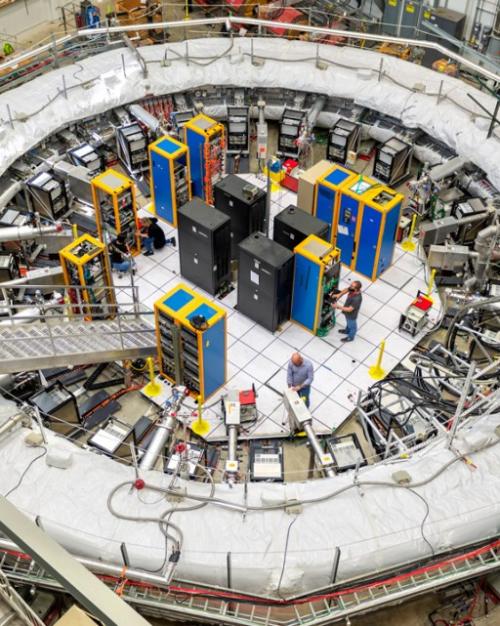
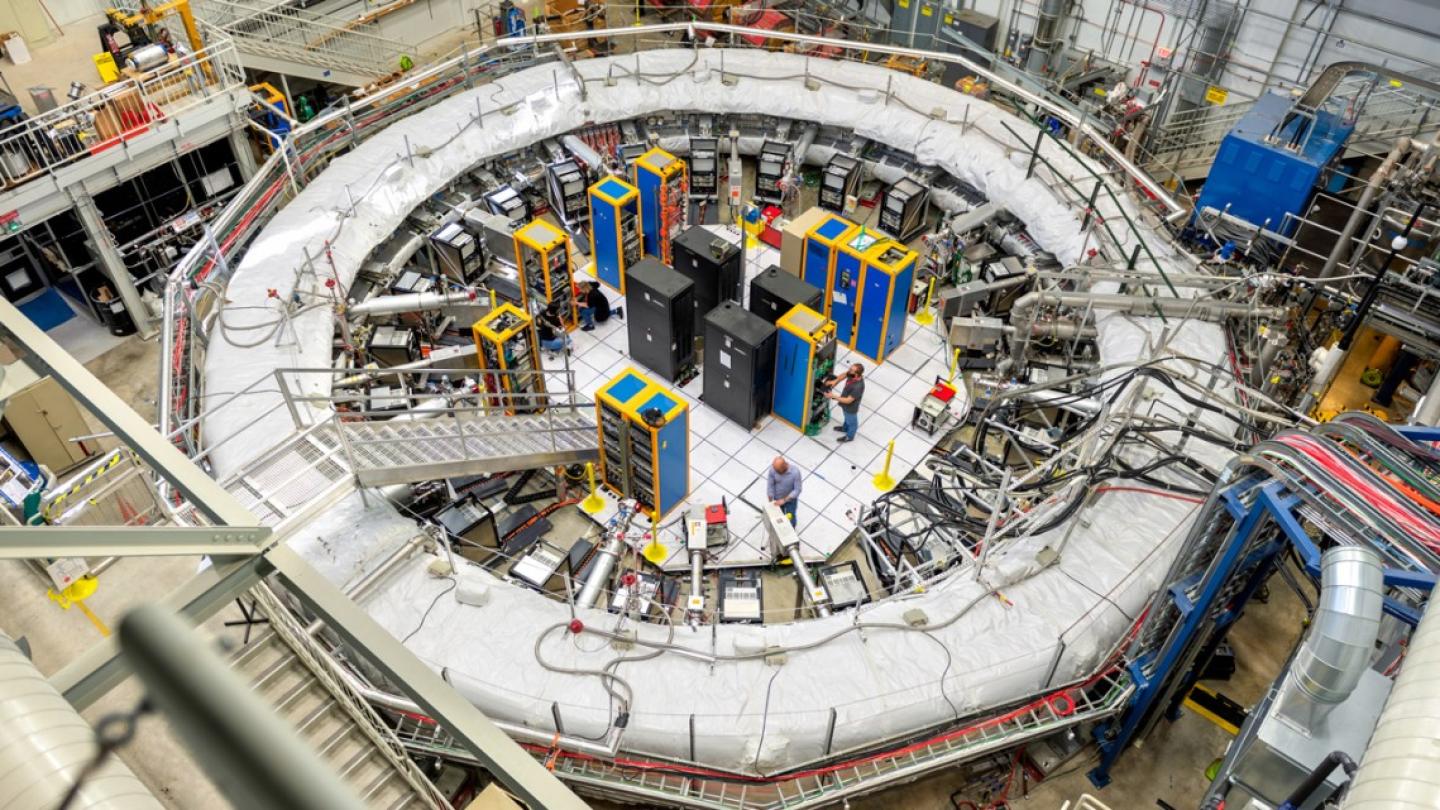
Gibbons led a team that made this level of precision possible by building hardware to measure billions of muons and analyze the data. His team’s digitizer modules were installed at the muon g-2 particle storage ring at Fermilab near Chicago.
“With the precision we have achieved, this measurement of g-2 for the muon gives us one of the most consequential tests of our fundamental description of matter, the Standard Model,” Gibbons said.
Gibbons will soon launch another experiment called PIONEER, which will measure the extremely fast decay of pions – unstable subatomic particles – using the intense pion beams at the Paul Scherrer Institute in Switzerland.
The Breakthrough Prize in Fundamental Physics was founded in 2012 by Yuri Milner to recognize those individuals who have made profound contributions to human knowledge. It is open to all physicists – theoretical, mathematical, experimental – working on the deepest mysteries of the universe.
Read the story in the Cornell Chronicle.
More News from A&S