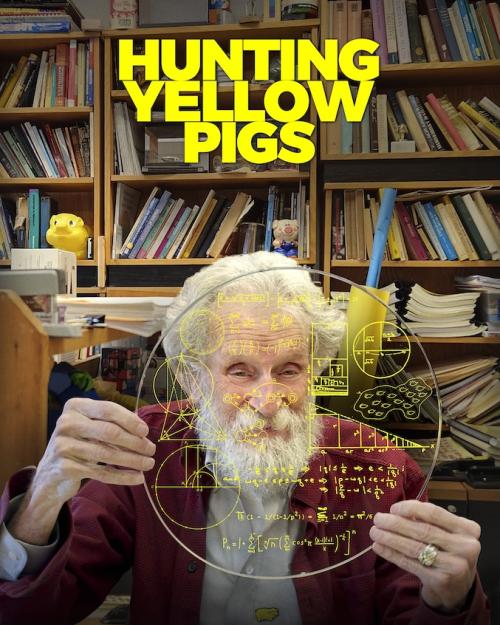
Cornell professor Steven Strogatz, a master math educator, credits a small, quirky summer program at Hampshire College with teaching him how to teach mathematics.
Strogatz, the Susan and Barton Winokur Distinguished Professor for the Public Understanding of Science and Mathematics and Stephen H. Weiss Presidential Fellow in the College of Arts and Sciences, appears in a new film, “Hunting Yellow Pigs,” that celebrates the Hampshire College Summer Studies in Mathematics (HCSSiM) and its unconventional approach to math education. The Department of Mathematics will host a screening with filmmaker Ming-I Huang on March 24 at 4 p.m. in Schwarz Auditorium, room 201 in Rockefeller Hall, preceded by a meet and greet at 3 p.m. Visit the film website to register.
“Hunting Yellow Pigs” will appeal, Strogatz said, to math-adjacent students and faculty at Cornell, quantitative people in the Ithaca area, math educators and parents of kids inclined toward math.
Anyone, really, can access and enjoy this film, said Jon Roberts, the film’s executive producer and an alumnus of HCSSiM.
“While the film touches on what math is, it doesn’t teach much, if any, mathematics,” he said. “Rather, it shows how to build a community that optimally creates, innovates, solves problems and discovers new knowledge in any field. Such communities revolve around human relationships. This film is really a love story on many levels.”
Founded in 1971 and housed at Hampshire College in Amherst, Mass., HCSSiM has had an outsized influence. Giving young “math whizzes” a place to belong and excel, it has produced a long list of alumni now prominent in math, science and technology. It’s been pivotal for many – including Strogatz.
As a college junior, he read about HCSSiM and decided it sounded like a perfect summer job for a math major. He drove up to Amherst, met the program director and was hired on the spot.
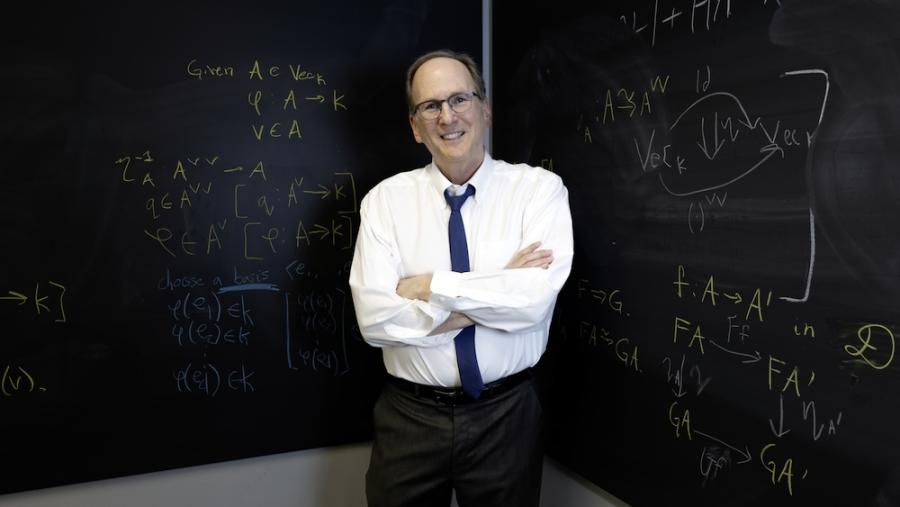
“I spent that summer working with high school students from around the country, helping them learn math and explore,” Strogatz said. “It was a fantastic experience for me because I’d always wanted to be a teacher or ultimately a professor, but I’d had no occasion to teach anyone. This was my first chance to practice some teaching.”
He vividly remembers watching Ken Hoffman, a senior faculty member, teach metric spaces to a room full of teens. Instead of dictating an axiom about the concept, Hoffman asked a question: What’s the distance between the sine function and the cosine function?
“At first, when you hear a question like that, it doesn’t make sense because the sine function and the cosine function are functions, not points,” Strogatz said. “What do you even mean? Well, that’s the whole point. Figuring out the right definition is part of the creativity.”
Running counter to an ecosystem in which competition – school math teams and weekend tournaments – is the usual course for young mathematicians, the Hampshire program is designed around cooperation and exploration, Strogatz said. It also promotes the social aspect of math, cultivating a quirky atmosphere in which a yellow pig is a mascot for the program and the number 17 is revered.
“The meaning of the yellow pigs has always been something of a mystery,” said Roberts. “We explore this in the film.”
He and Ming-I Huang – his spouse as well as the filmmaker – also explore why HCSSiM has been so influential and highlight the contributions of founder and longtime director David C. Kelly, who passed away in 2025.
Hampshire’s questions-first approach is honest to the mathematical experience, Strogatz said – it’s how math is done at the highest levels. It’s also stuck with him through his career as a professor in the classroom and in public forums such as his books, New York Times pieces and the Joy of Why podcast.
“The idea that you start with the concrete before going into the abstract was a lesson I learned there,” Strogatz said. “If I had to boil down in one sentence the most important thing you can do as a teacher – and I’ve thought about it a lot – I think it comes from the Hampshire experience: You have to help people love the question.”
More News from A&S


‘The New Population Problem’ examined in Phi Beta Kappa lecture Oct. 28
Phi Beta Kappa