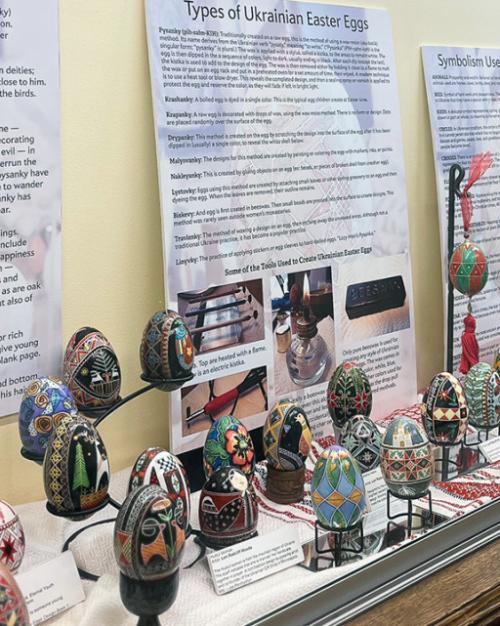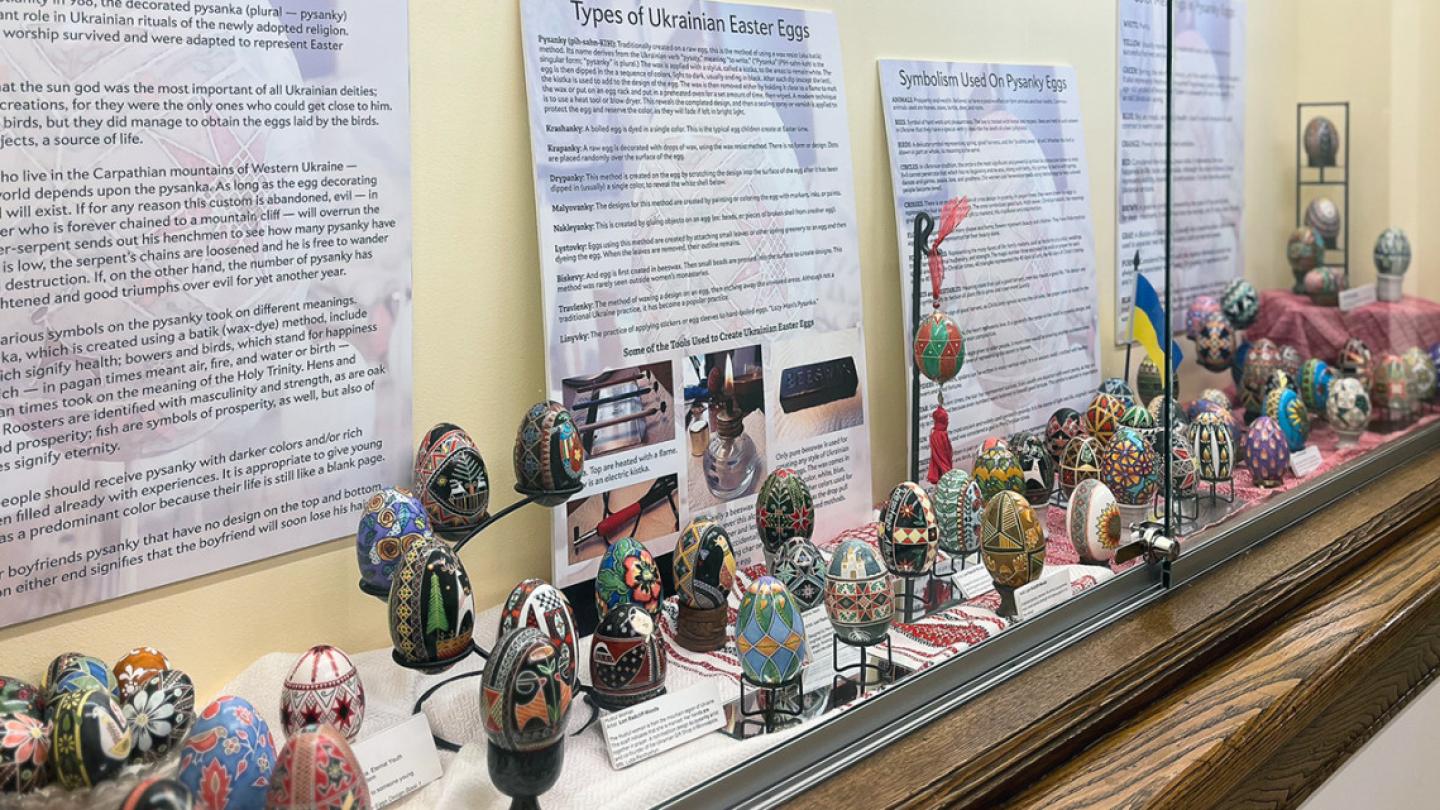
An exhibit of brilliantly colored Ukrainian Easter eggs, or pysanky, is one of several new initiatives Cornell’s Ukrainian Program is undertaking to bring the culture, language and history of Ukraine to the Cornell community.
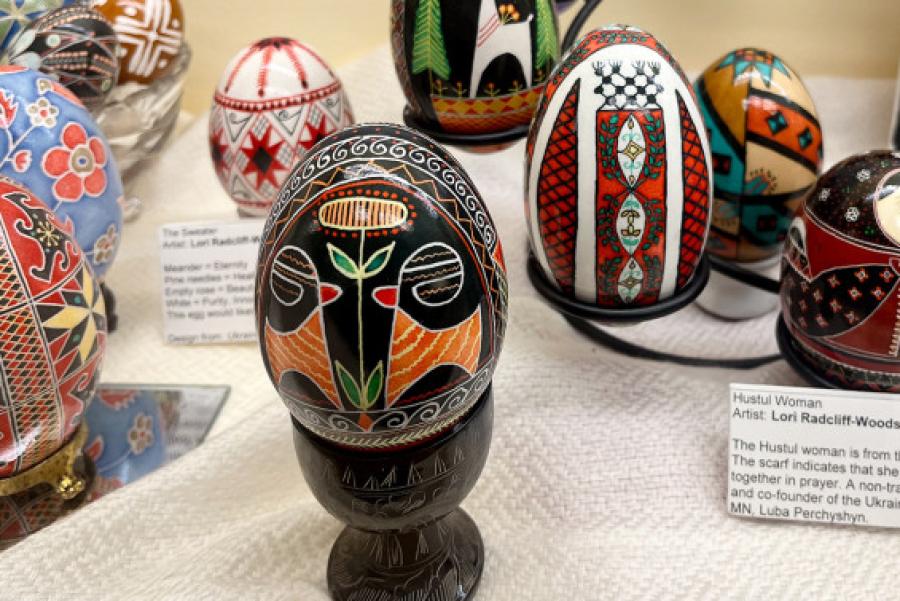
The pysanky, created by Cornell staff member Lori Radcliff-Woods, ag districts data manager for the Institute for Resource Information Sciences, Soil and Crop Sciences, in the School of Integrative Plant Science, College of Agriculture and Life Sciences, are on display in a case in the lower level of Goldwin Smith Hall, near the Temple of Zeus, until the end of the semester and showcase a variety of styles, symbols and colors.
Radcliff-Woods, who is Polish, has been creating the eggs since 2003, when she learned the technique at a workshop. The art of pysanky is popular in Poland as well as Ukraine, and she’s created eggs based on traditional patterns, in addition to her own designs.
“I’ve given them away, donated them for benefits, sold some and contributed two to an auction that raised money for Ukraine after the war started,” she said, adding that the eggs were also on exhibit at Mann Library in spring 2025.
The Goldwin Smith exhibit was the brainchild of Krystyna Golovakova, lecturer of Ukrainian and Russian in the Department of Comparative Literature in the College of Arts and Sciences.
“Bringing this exhibition to Cornell is important because it allows students to encounter Ukrainian culture not only through current events, but through a symbolic language that has been preserved for centuries,” she said. “In my teaching, I aim to create similar spaces – through literature, language and song – where students can engage more deeply and reflectively.”
The pysanky tradition can be traced to pagan times, when people who lived in the region now known as Ukraine decorated eggs with symbols of nature to celebrate spring and rebirth, Radcliff-Woods said. With the advent of Christianity, the eggs became associated with Easter and the resurrection of Christ. Pysanky artists use a stylus, layers of wax and dye to create the intricate patterns.
Golovakova’s classes include discussions of pysanky and other Ukrainian artistic and cultural traditions, and Ukrainian students have offered workshops for other students to learn how to create pysanky.
Since arriving at Cornell in 2022, Golovakova has introduced four Ukrainian language and culture classes into the Cornell curriculum. There are also four upper-level Ukrainian language classes offered through the Shared Course Initiative of Cornell’s Language Resource Center; this agreement between Columbia, Cornell and Yale universities shares instruction in the less commonly taught languages through video conferencing.
Supported by a donor gift, Golovakova has expanded Ukrainian-focused initiatives beyond the classroom. She helped organize the Ukraine in Translation symposium last fall and a screening of the film “Mavka: The Forest Song” in fall 2026 at Cornell Cinema. A lecture-recital, Voices of Resilience, on May 2 will also include Ukrainian themes.
Russia’s invasion of Ukraine in 2022 sparked an interest in Ukrainian classes at Cornell, Golovakova said, with students signing up for courses as a way to show support and learn more about the culture. But four years later, students continue to be interested because they want to understand the culture, language and history beyond the conflict, she said.
Haiar Isliamov ’28, who grew up in Ukraine and immigrated to the U.S. with his family when the war started, said the Understanding Ukraine class has added to his knowledge about his native country.
“The class brings perspective to what’s going on through cultural, historical and linguistic lenses,” said Isliamov, an applied economics and management major with a history minor in the Dyson School of Applied Economics and Management, in the Cornell SC Johnson College of Business.
Aidan Zinck ’26, a biological sciences major in the College of Agriculture and Life Sciences, is taking both a language and a culture class because of his interest in Slavic languages.
“Very few universities offer classes in Ukraine,” he said. “I wanted to take both classes because language informs the culture but at the same time the culture shapes how language is used. I want to understand how people in Ukraine would naturally express themselves.”
In the past year, Golovakova expanded the focus of the Understanding Ukraine class and added a new Reading in Ukrainian advanced course focused on literature and taught completely in Ukrainian. With both Russian and Ukrainian heritage, Golovakova said she’s also interested in creating a class that explores the similarities and differences between the two countries.
“The unique perspective I bring to students is my own lived experience, not just something they’re reading in textbooks,” she said. “I’m interested in developing a course that explores the complex linguistic, cultural and historical relationships between Ukraine and Russia – where the two traditions come together and where they part ways.
“By looking at these both together and separately, students can better understand the region and its dynamics, and start thinking more critically about the possibilities for peace.”
Read the story in the Cornell Chronicle.
More News from A&S

Annetta Alexandridis commemorated through installation, Oct. 31 memorial
History of Art and Visual Studies
Shakespeare’s 'Twelfth Night:' Mad Love, Mad Music
Performing and Media Arts
Pinkham’s ‘The Oak and the Larch’ wins Pushkin House Book Prize
Comparative literature