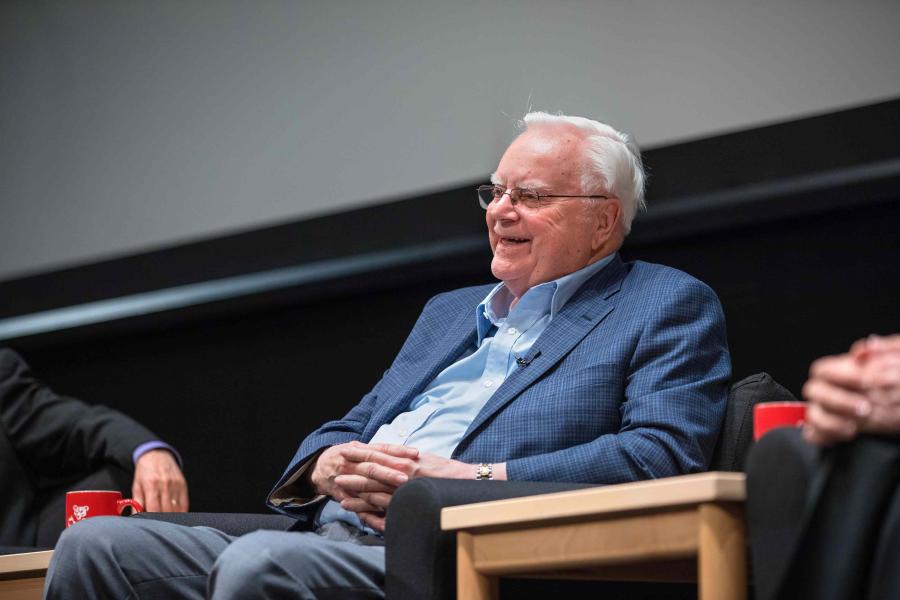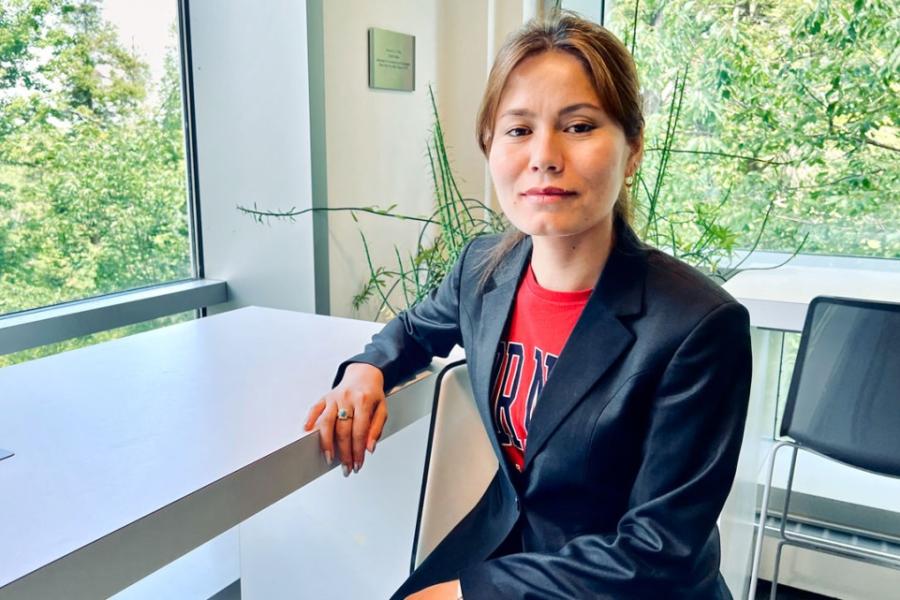
Steeped in Big Red lore since childhood, they ponder their favorite artifacts, what Ezra would think of today’s University, and more.
Provided
This series of images, captured by three high-speed video cameras filming at 4,000 frames per second, track a dragonfly as it was released upside-down from a magnetic tether and rolled 180 degrees to reorient itself.
Cornell faculty and their community partners will tell the stories of local migrant farmworkers, use documentary film to better understand climate change and dispossession, learn how migratory birds are affected by drug trafficking and more.
Dave Burbank/Cornell University
Jeffrey Palmer (left) and Malte Ziewitz, recipients of the 2022 Robert and Helen Appel Fellowship for Humanists and Social Scientists, at a May 10 reception.
"These faculty members and graduate teaching assistants have made tremendous contributions for the benefit of our students, guiding their educational paths and molding their experiences."
Cornell researchers contributed to the first direct visual evidence of something compact and very massive at the center of the Milky Way.
Lisa Banlaki Frank/CAM
In fall 2018, Li came to campus for a visit during which she spoke to classes, held training sessions with Cornell Dining staff, met with students, and did a cooking demo in Okenshields, where several Mei Mei dishes were featured at dinner.
The College has awarded seven New Frontier Grants totaling $1.25 million to faculty members pursuing critical developments in areas across sciences and humanities.
Ryan Young / Cornell University
2022 Cornell Campus-Community Leadership Award winners Claire Deng ’22 (left) and Temilola (Lola) Adepoju ’22
The Graduate School awarded over 100 Research Travel Grants totaling $204,196 in 2021-22, the largest group of grants awarded since the pandemic began interrupting travel.
The music department's annual springtime festival of world-class chamber music will feature performances by exceptional guest artists from around the world.
Provided
A hole 22 meters in diameter near the summit of Cerro Chajnantor in Chile’s Atacama Desert, at an elevation of 18,400 feet stands ready for the cement foundation on which the Fred Young Submillimeter Telescope will one day rest.
Project scientists are looking forward to collecting data that will give them insight into the universe’s earliest days; the telescope will also play a role in the search for gravitational waves and dark matter.