Researchers discovered that the atmosphere of exoplanet HD149026b, a ‘hot Jupiter’ orbiting a star comparable to our sun, is super-abundant in the heavier elements carbon and oxygen.
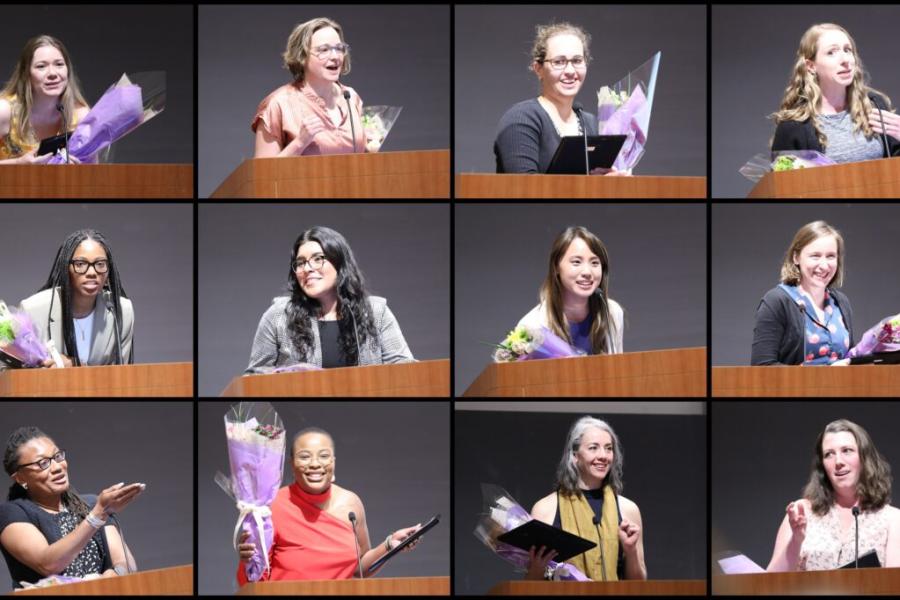
Fangming Cui, psychology, and Susannah Sharpless, English language and literature, are among eight doctoral students advancing to the final round of the 2023 Three Minute Thesis competition.
Jason Koski/Cornell University
Margaret Rossiter, the Marie Underhill Noll Emerita Professor of the History of Science in the College of Arts and Sciences.
Her three-volume work, “Women Scientists in America,” sheds light on the many ways women were involved in the advancement of science, as well as how they were pushed out of the field.
Ryan Young/Cornell University
Darryl Seligman, a postdoctoral researcher in the Department of Astronomy in the College of Arts and Sciences, and a National Science Foundation postdoctoral fellow.
Planning to harness the power of AI are A&S researchers from physics; ecology and evolutionary biology; chemistry and chemical biology; and neurobiology and behavior
Government scholar Sarah Kreps comments on today's expected appearance of TikTok CEO Shou Zi Chew on Capitol Hill amidst app-related national security concerns.
Cornell research is shining a new light – via thermal imaging of mice – on how urine scent mark behavior changes depending on shifting social conditions.
Janne Simoes/Unsplash
U.S. Capitol Building
Identifying AI risks
Democracies in the age of AI can feel more fragile than ever – how do we distinguish legitimate political messaging from malicious bots? What happens when elected leaders can’t distinguish AI-generated advocacy from human? Political scientist at Cornell are identifying where the dangers lie and what can be done to mitigate them.
Research in the realm of accelerator physics focuses a lot on where you get the particles from. My group’s expertise is creating and manipulating electron beams. We’re typically interested in studying a process called photon emission by way of using light to impinge on a specially engineered material that will emit electrons when illuminated. My group are experts in generating high brightness electron beams via photoemission, using light to generate electrons.
I joined the Compact Muon Solenoid (CMS) experiment at the Large Hadron Collider (LHC) in 2005. The project then was already in the middle of construction and primarily I worked on the pixel detector and getting that ready for data taking, which started in 2010. But already I was thinking about what we want to do in the future. So I got involved with the H luminosity LHC upgrade, the next major upgrade of the facility at CERN that will allow us to take data at a rate that is in order of magnitude higher than what we have been doing so far. Starting about 2014, we really started seriously to make the plans for this work which had been listed as the highest priority project for the LHC upgrades.