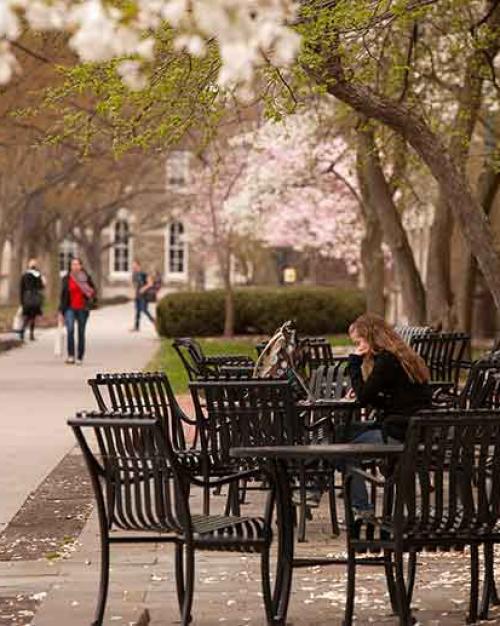
As a student of the College of Arts & Sciences, I find that I spend most of my time on or around the Arts Quad.
Whether that be studying at Olin Library, in class at Morrill, McGraw or White halls, or getting coffee at the Temple of Zeus, it is in these places where I feel that I am attaining a liberal arts college experience.

To sit on the steps of Goldwin-Smith Hall, a building of historic grandeur and significance in its architecture and appearance, locates myself, very fortunately, in the fount of knowledge the West can provide. It is within these halls, these classrooms, where I feel that I am benefitting from centuries of critical thought, deep questions and explorations into finding meaning in the human experience.
It is in these buildings, outlining the Arts Quad, where I have made my first contacts with Plato and Aristotle, Saint Augustine and Saint Thomas Aquinas, the Tragedians and the Modernists, the Baroque and the Contemporary, the revolutionary and the reactionary, to name but a few.
What grander arena to learn the history of the world? At Cornell, do make an effort to seek out these thinkers, ideas and movements. My advice would be to start first with the Arts Quad.
More News from A&S