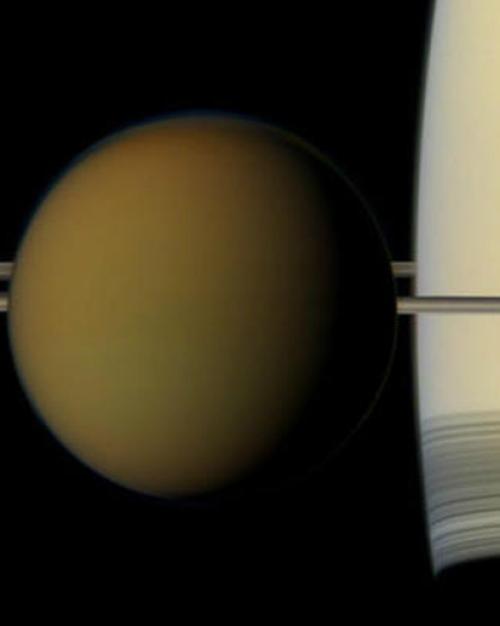
Alexander G. Hayes, assistant professor of astronomy, first began studying Titan as a graduate student, Hayes' research is described in this Cornell Research story.
“Where else can you say it’s raining right now, other than on Earth?” Hayes says in the story about Saturn’s largest moon. “It has strikingly similar processes acting on its surface, generating landforms including lakes, channels, and dunes—everything you have here, you have there. Titan’s methane-based hydrologic system works just like Earth’s water cycle, but does so in a completely alien environment.”
Read the full Cornell Research story here.
More News from A&S


‘The New Population Problem’ examined in Phi Beta Kappa lecture Oct. 28
Phi Beta Kappa
A&S Communications


Soprano Dawn Upshaw visits campus as A.D. White Professor-at-Large
A.D. White Professors at Large
A&S Communications