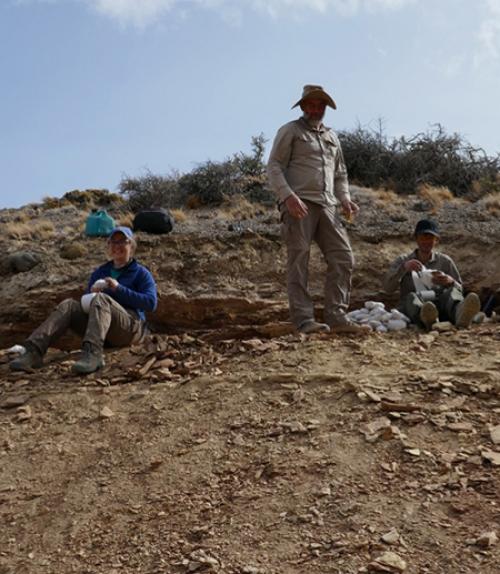
"There is something cathartic about smashing rocks on a hillside, miles away from civilization, in pursuit of fossils. Each swing of the hand-pick uncovers part of a mystery. A crack forms, then deepens, and suddenly the rock splits open—to reveal a fossil or reveal nothing. A fossil is set aside. An empty rock is tossed down the hillside. The process repeats—onto the next rock."
That's the beginning of a Cornell Research piece written by Colton Poore '20, an Arts & Sciences student and one of two undergraduate researchers working under María Alejandra Gandolfo-Nixon, associate professor of plant biology, and a team of researchers looking for fossils in Patagonia, Argentina. He is a double major in biological sciences and English.
Read the story on the Cornell Research website.
More News from A&S

Society for the Humanities Fellows to Explore “Survival” at Fall Conference
Society for the Humanities