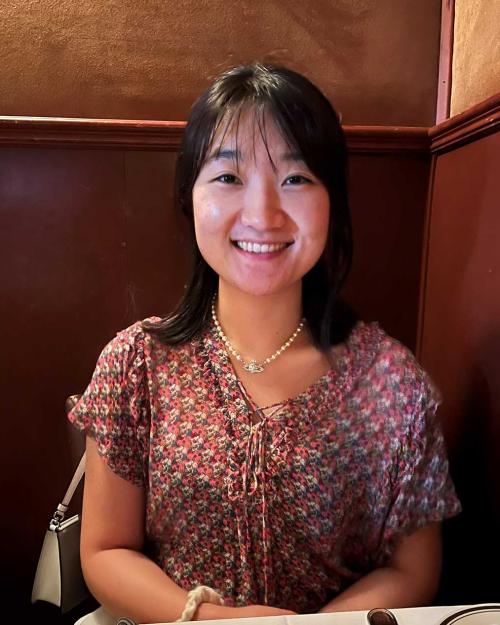
Youn Jue (Eunice) Bae, assistant professor of chemistry and chemical biology in the College of Arts and Sciences, is a member of a team that’s won funding from the inaugural Scialog Award focused on Quantum Matter and Information.
Bae is part of the three-person group researching “Quantum Entanglement of Skyrmion-Antiskyrmion Pairs.” She and her teammates, Serena Eley, University of Washington and Kazuki Ikeda, University of Massachusetts Boston, will combine theoretical calculation and experiments to predict reliable ways to generate entangled pairs of tiny whirlpool-like magnetic structures, called skymrions, and their counterparts, antiskyrmions. Each of the three researchers will receive $60,000 in direct costs as part of the award.
Presented by the Research Corporation for Science Advancement (RCSA), Scialog (short for “science + dialogue”) Awards aim to accelerate breakthroughs by building creative networks of scientists from the U.S. and Canada and stimulating conversation around scientific themes of global importance.
Scialog: Quantum Matter and Information is a three-year initiative aiming to promote broader interactions among different sectors of the quantum science community and spark interdisciplinary projects to enhance understanding of the quantum world.
“It’s a remarkable time for major advances in quantum materials and information, and Fellows at this Scialog are in the thick of it,” said RCSA President and CEO Eric Isaacs. “The ideas that come out of this initiative could be game-changing.”
With her collaborators, Bae will pursue a practical path to generating skyrmion–antiskyrmion pairs on demand and directly tracking how their correlations evolve in space and time, an essential step toward using these chiral magnetic textures as “building blocks” for quantum-connected devices. Bae’s role is to develop and apply an optical platform that can create, probe and control quantum correlated skyrmion pairs.
“Skyrmions and antiskyrmions are fascinating because they’re robust, nanoscale magnetic objects – but we still lack deterministic control and a practical way to watch how paired textures evolve in real time,” Bae said. “By combining theory, simulation and ultrafast optical experiments, we aim to establish a platform that can both generate these pairs reliably and probe their quantum-correlated dynamics, opening new opportunities for compact, chip-scale quantum sensors and devices that couple light and magnetism.”
In all, seven research teams – 19 individual researchers – are receiving Scialog Awards on the Quantum Matter and Information theme this year.
In recent years, Scialog Awards on various themes have been given to Cornell researchers Phillip Milner, associate professor of chemistry and chemical biology (A&S); Anna H.Q. Ho, assistant professor of astronomy (A&S) and Antonio Fernandez-Ruiz, assistant professor and Nancy and Peter Meinig Family Investigator in the Life Sciences.
More News from A&S