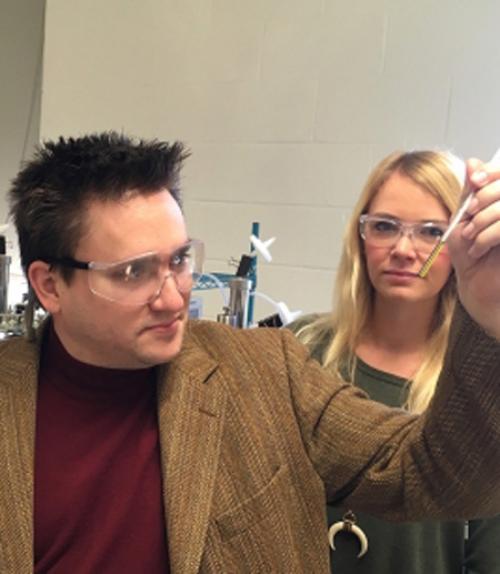
Associate Professor of Chemistry Kyle Lancaster was recently honored with the National Fresenius Award from Phi Lambda Upsilon.
Phi Lambda Upsilon, which promotes high scholarship in pure and applied chemistry, established the prize in 1965 in recognition of Carl Remigius Fresenius to honor outstanding chemists early in their professional careers. Recipients demonstrate outstanding research, teaching and administration in their fields.
The Lancaster Group employs synthesis, biochemistry and a broad range of spectroscopic methods to explore small molecule reactivity as mediated by transition metals. Their work has been featured in prestigious journals such as Science, Proceedings of the National Academy of Sciences of the United States of American, and the Journal of American Chemistry. He has been received early career awards from the U.S. Department of Energy and National Science Foundation, is an Alfred P. Sloan Fellow, and has been listed as one of Forbes' 30 under 30.
The award will be presented at the Spring 2020 National Meeting of the American Chemical Society.
More News from A&S