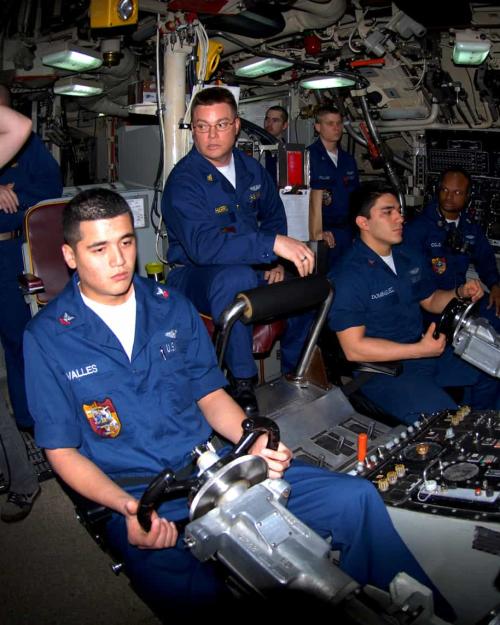
The United States will deploy nuclear-armed submarines to South Korea for the first time in 40 years — part of a new agreement, signed Wednesday, and signaling Washington's commitment to defend Seoul against nuclear threats from North Korea.
David Silbey is an associate professor of history at Cornell University where he specializes in military history, defense policy and battlefield analysis. In addition to sending a message to North Korea, he says the subs also represent a tightening circle around China.
Silbey says:
“The obvious target is North Korea, which has a worrying tendency to lob its own missiles in random directions. This is a way of showing the North Koreans that the U.S. is committed to its alliance with South Korea.
“The Chinese will also sit up and take notice because having boomers that close puts Beijing easily in reach. A specific worry the Chinese would have is a ‘decapitation strike’ where the U.S. tries to take out Chinese leadership with a rapid missile strike from a close off-shore missile submarine and then follows with a full salvo of missiles from farther away. It’s one strategy for a first strike, aimed at shutting down a retaliatory strike. We may not think that’s plausible, but the Chinese have to plan on capability, not necessarily intent. It’ll make them nervous.
“The counterpoint to all this is that having U.S. SSBN’s in that area also makes them vulnerable. Missile submarines aim to hide in deep water; putting them in the relatively shallow Sea of Japan makes them much easier to see and that will make the U.S. nervous.”
For interviews contact:
Adam Allington
cell: 231-620-7180
More News from A&S

Annetta Alexandridis commemorated through installation, Oct. 31 memorial
History of Art and Visual Studies
Shakespeare’s 'Twelfth Night:' Mad Love, Mad Music
Performing and Media Arts
Pinkham’s ‘The Oak and the Larch’ wins Pushkin House Book Prize
Comparative literature