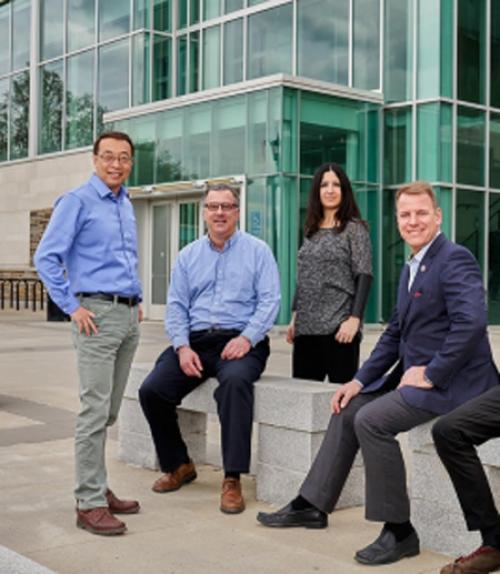
For all the medical advances in recent years, neurological and psychiatric disorders— Alzheimer’s Disease, Parkinson’s Disease, autism, and schizophrenia—remain largely a mystery. One reason is the incredibly complex structure of the brain. To encourage exploration of this unknown territory, the National Science Foundation (NSF) awarded Cornell University $9 million over five years to establish a neurotechnology hub, dedicated to developing new technologies for imaging the brain, then disseminating them to the wider neuroscience community. This Cornell Research story explores this neurotechnology hub and its possibilities.
The focus of the Cornell Neurotechnology (NeuroNex) Hub is optical imaging. Chris Xu, Applied and Engineering Physics, who is the lead principal investigator (PI) for the hub, says, “We’re pushing for imaging depth, speed, and volume. We want to image as much of the brain and the nervous system as we can in as short of a time as we can. That will enable us to attack neuroscience problems that are currently impossible.”
Co-PIs include Joseph R. Fetcho, Neurobiology and Behavior; Nilay Yapici, Neurobiology and Behavior; Chris Schaffer, Meinig School of Biomedical Engineering; and Mert R. Sabuncu, Electrical and Computer Engineering/Meinig School of Biomedical Engineering.
Continue reading the full story on the Cornell Research website
More News from A&S


Soprano Dawn Upshaw visits campus as A.D. White Professor-at-Large
A.D. White Professors at Large
A&S Career Development gets facelift, joins new collaborations across campus
Career development