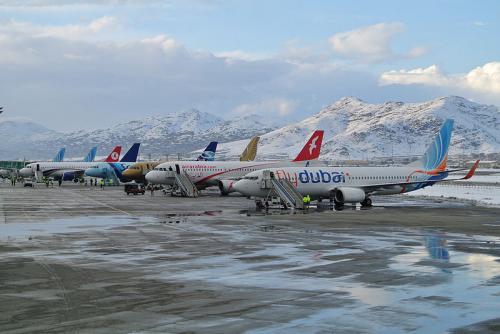
As evacuations continue from Afghanistan, the U.S. Department of Defense confirmed that two suicide bombers detonated in Kabul today, killing at least 12 U.S. service members.
David Silbey, adjunct associate professor of history, studies wars of the 20th century and the asymmetric responses (guerrilla warfare, insurgency and terrorism) to the wars that evolved after 1945. He recently published a book, “The Other Face of Battle: America's Forgotten Wars and the Experience of Combat.”
Silbey says:
“Staying in these kinds of small wars is often politically easier than leaving them, and this week illustrated exactly why. The U.S. achieved its real strategic goal of killing Osama Bin Laden in 2011, but previous Presidents worried about exactly the kind of intense political fallout that President Biden is getting.
“The suicide bombings at the airport are a clear sign of how fragile the American position is, with American soldiers and Marines mingling with thousands of civilians, while highly vulnerable cargo planes take off and land. The closest historical parallel is the suicide bombing of the Marine barracks in Lebanon in 1983, which killed 241 Marines in a forgotten conflict where the U.S. found itself fighting in a complicated war we didn’t quite understand.”
For media inquiries, contact Linda Glaser, news & media relations manager, lbg37@cornell.edu, 607-255-8942.
More News from A&S


Cornell biologist named Blavatnik Award finalist for work with rewilded mice
Neurobiology and behavior
Cornell mathematicians win grants to ensure AI safety, research integrity
Mathematics