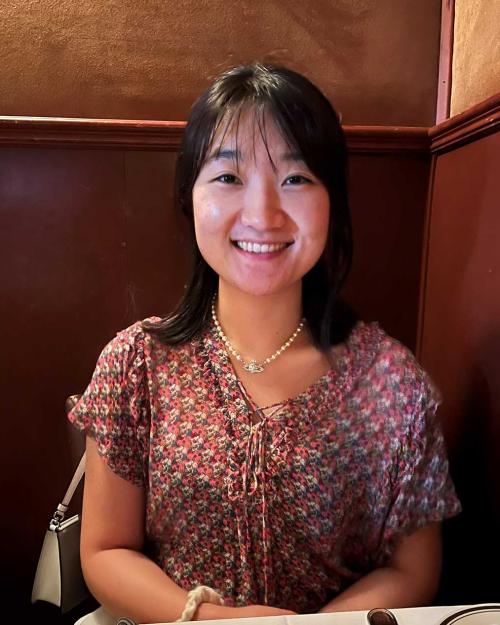
Takunda Chikuvire
Biological Sciences
Harare, Zimbabwe
Why did you choose Cornell?
Long before I ever set foot on Cornell's campus, I was captivated by a single phrase: "any person, any study." It felt less like a slogan and more like a promise, one that spoke directly to who I was: a curious, driven student from Zimbabwe with interests that refused to fit neatly into a single box.
I came to Cornell because I knew it was a place where I could pursue research that truly mattered. I had already been reading about molecular adaptations in organisms, fascinated by the idea that something as small as a single gene could determine whether an organism survives or falls ill. I wanted a university where I wouldn't just read about science but do it. Cornell's reputation as a world-class research institution meant that those opportunities would exist and be within reach.
But beyond research, it was the community that called to me. Cornell's diversity of people, disciplines and ideas promised an education that extended far beyond the classroom. I wanted to learn alongside students whose backgrounds and perspectives were different from my own, because I believed that was where real intellectual growth happened. Cornell offered me a degree and a world.

What are the most valuable skills you gained from your Arts & Sciences education?
Two skills stand out above all others: interdisciplinary thinking and the confidence to work independently.
Cornell's liberal arts curriculum refused to let me stay in one lane. I was a biological sciences student who took courses on Black feminist health theory, ecological physiology and the history of activism. At first, those felt like detours. In time, I realized they were the education. Learning to draw connections across disciplines, to bring a social lens to a clinical question, or a biological framework to a policy problem, became one of the most powerful tools I have. I apply it in my research constantly, and I expect to keep applying it for the rest of my career.
Equally important was the independence I developed. Cornell gave me the freedom to pursue the questions that genuinely excited me, to design my own research directions, and to take ownership of my intellectual journey. That freedom was sometimes uncomfortable; there's no roadmap for independent inquiry, but it taught me to trust my instincts, tolerate uncertainty and keep moving forward even without a guaranteed answer at the end. That, more than any single course, prepared me for a life in science.
What have you accomplished as a Cornell student that you are most proud of?
In my undergraduate application, I wrote that "engaging in research is an opportunity to practically apply what I have learned – theoretical knowledge needs to be reinforced with practical experience." Four years later, I can say that I fulfilled and exceeded that promise to myself.
My research journey began in the Vitousek Lab, where I started by collecting biological samples from wild birds in the field and grew into leading an independent honors thesis investigating how early-life environment shapes stress physiology across different dispersal phenotypes in tree swallows. Analyzing more than a decade's worth of longitudinal data using R, I learned statistical methods, patience and the rigor that real science demands.

From there, my curiosity kept pulling me further. I contributed to a metascience project at the Stanford Cardiovascular Research Institute examining the underrepresentation of Asian American, Native Hawaiian and Pacific Islander populations in cardiovascular clinical trials, work with direct implications for health equity. At Washington University School of Medicine, I designed a spatial transcriptomics pipeline to map pediatric kidney disease at single-cell resolution. At the Boyd Lab at Stanford, I worked alongside surgeons evaluating biodegradable support structures for coronary artery bypass grafting. Most recently, as a youth research fellow for Jobs for the Future, I am leading qualitative research on how college students navigate career decisions using AI tools and human mentors.
Each project taught me something different: a new method, a new field, a new way of asking questions. But more than any individual finding, what I'm proudest of is the researcher I became in the process: someone who can move fluidly across disciplines, ask meaningful questions and commit to the slow, rigorous work of finding answers.
Who or what influenced your Cornell education the most?
Before any professor, any advisor or any lab, there was my mother.
She never went to college, but she understood, perhaps more deeply than anyone, what an education could mean for a life. I grew up watching her till fields before sunrise, so our family would have food on the table, and sell groceries door-to-door to supplement my father's income, all so that I could have bus fare to school and my fees paid on time. She never complained. She never wavered. She just worked with a quiet ferocity that I have spent my whole life trying to match. When Cornell felt impossible, when the coursework was relentless, the self-doubt was loud, and I came close to the edge of giving up, she was the one who pulled me back. Not with grand speeches, but with the memory of everything she had already sacrificed to get me here. She is, in every sense of the word, a force.
The resilience I bring to my research, my leadership and my aspirations, so much of it was forged watching her.
Beyond my mother, mentorship shaped my Cornell experience more than anything else. When I joined the Vitousek Lab in the summer of 2023, I was a first-generation student from Zimbabwe trying to figure out how to build a research career from scratch. Dr. Maren Vitousek gave me a project and invested in me. She opened doors I didn't know existed, wrote recommendations that moved my applications forward, and connected me with opportunities that have defined my undergraduate career. Almost every major research experience I've had can be traced, in some way, back to her belief in me.
My advisors, Jeff McCaffrey from the Biology Scholars Program and Foula Dimopoulos from Cornell's Pre-Professional Program, shaped me just as deeply. They showed up consistently at the right moments, with the right words and with genuine investment in where I was headed.
Because of what mentorship has meant to me, I've made it a priority to pay it forward. I actively mentor underclass students, particularly those trying to get started in research, because I know how much a single conversation, a single introduction or a single recommendation can change someone's trajectory. I know because it changed mine.
If you were to offer advice to an incoming first-year student, what would you say?
Say yes before you feel ready.
The opportunities that have shaped me most were ones I almost didn't pursue because I felt underqualified, or uncertain, or afraid of wasting someone's time. What I've learned is that those feelings are almost universal and seldom accurate. The only way to find out what you're capable of is to step into rooms where you're not sure you belong.
Pursue things outside your primary interests, too. Some of the most valuable skills I've gained came from experiences that seemed unrelated to my goals at the time. They weren't. Transferable skills, such as how to communicate, lead and think across disciplines, are often built in unexpected places.
And please: don't let fear of rejection stop you from applying. You will not get everything you go after. That's not failure, but just the process. The students who accumulate the most meaningful opportunities aren't the ones who never hear "no." They're the ones who keep going anyway.
You miss 100 percent of the shots you don't take. So take the shot.
Every year, our faculty nominate graduating Arts & Sciences students to be featured as part of our Extraordinary Journeys series. Read more about the Class of 2026.
More News from A&S