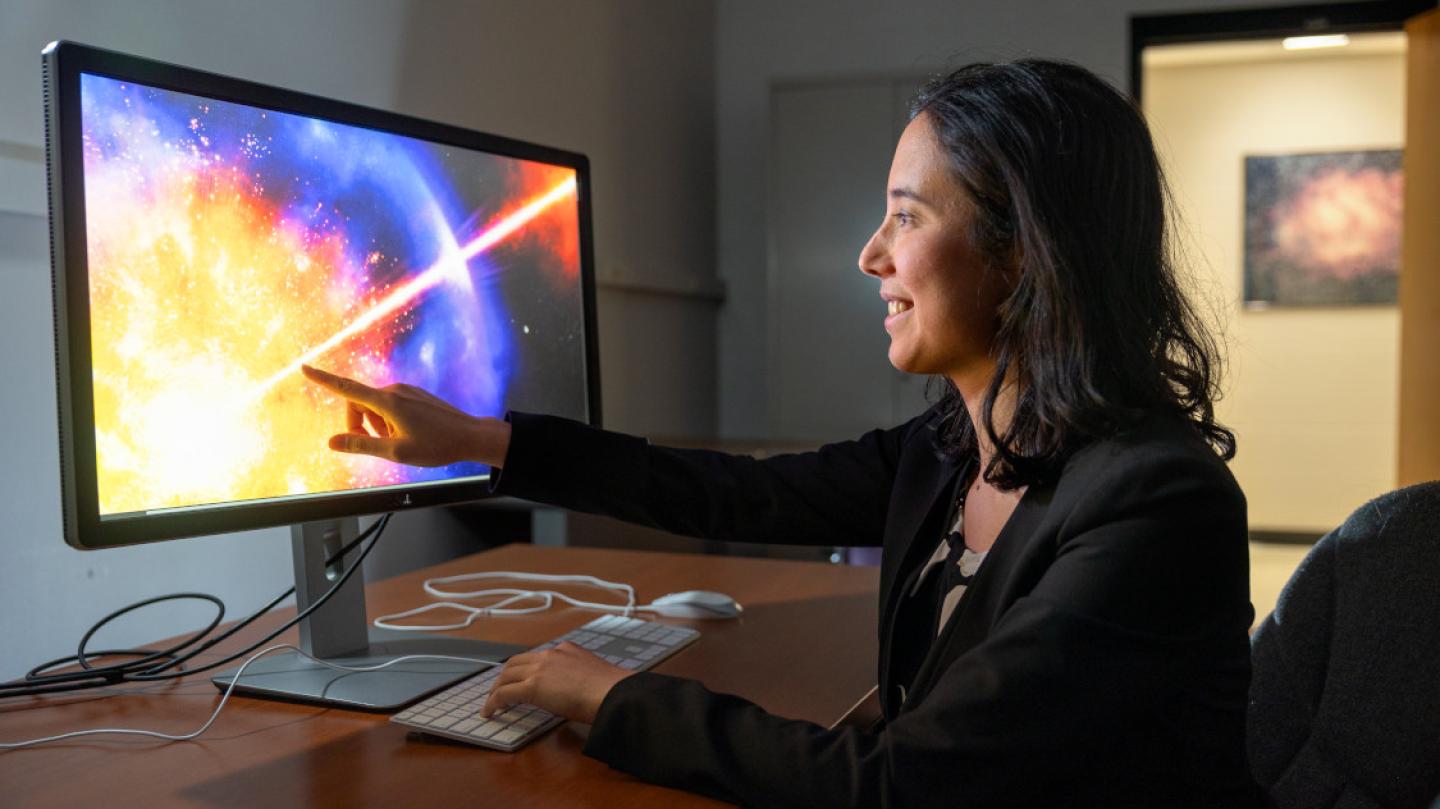
Anna Y. Q. Ho, assistant professor of astronomy in the College of Arts and Sciences, has been awarded the 2026 Newton Lacy Pierce Prize by the American Astronomical Society (AAS).
Given annually for outstanding achievement in observational astronomical research based on measurements of radiation from an astronomical object, the Pierce Prize this year recognizes Ho’s pioneering investigations of extreme explosions powered by stellar death. Her research has revealed ultra-bright, short-duration optical flaring associated with a new class of visual events called Luminous Fast Blue Optical Transients (LFBOTs).
LFBOTs are thought to be associated with the destruction of stars, and Ho is on the front lines of observing and interpreting these events, which are rare, poorly understood, and often linked to strange phenomena. She is co-investigator on research announced Jan. 6 at the American Association for the Advancement of Science conference that identifies a spectacular event of this sort, which likely arose when a black hole shredded a massive star. Ho discovered the event, AT2024wpp, almost immediately after its light reached a ground-based observatory in California. She and collaborators flagged it as a potential LFBOT.
Ho was first author in 2023 of another paper in which an LFBOT displayed unprecedented behavior. She led observations of repeated energetic flares, associated with LFBOT AT2022tsd, that lasted only a few minutes each yet repeated over several months – a phenomenon that had never been seen before.
In general, Ho’s research uses telescopes all over the world and in space to study the lives and deaths of stars and other energetic phenomena.
“The origin of LFBOTs is a pressing mystery in time-domain astronomy,” Ho said. “The proposed models would all be important for our understanding of the lives and deaths of stars, as well as the formation and growth of black holes. I am so fortunate to be able to tackle cosmic puzzles with my students, postdocs and collaborators. This work is the result of many hands on deck and I am grateful for their contributions.”
In 2025, Ho won an inaugural Scialog: Early Science with the LSST award to advance the foundational science done by the Vera C. Rubin Observatory’s upcoming Legacy Survey of Space and Time (LSST). She is also a Packard Fellow for Science and Engineering and an Alfred P. Sloan Research Fellow in Physics.
More News from A&S