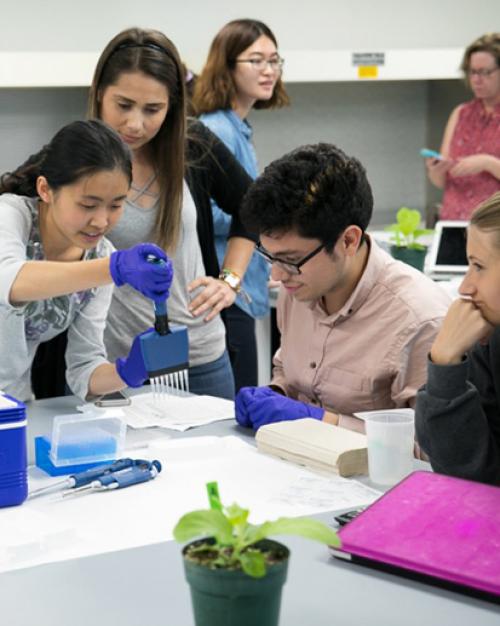
In an Invited Comment in Nature Physics that published on May 31, physicist Natasha Holmes and her co-author describe how undergraduate labs that encourage investigation and decision-making are more positive for students – and are more effective -- than those that focus on verification of concepts in textbooks.
“Rather than using the experiments in a lab to demonstrate a particular theoretical model, labs should showcase what it means to do experimental physics: the approach, techniques, skills and ways of thinking when conducting authentic physics experiments. This focus is important not only for future scientists but also for citizens, to better equip them to interact with the complexity of the world and interpret scientific advancement in light of uncertainty,” write Holmes, Ann S. Bowers Assistant Professor in the Department of Physics, and Emily Smith, a former physics postdoctoral researcher at Cornell.
Holmes’ lab studies teaching and learning in physics and other science, technology, engineering, and math (STEM) courses. She is a founder of the Cornell Discipline-based Education Research group that brings together researchers from across the campus for collaborative scholarship in this emerging field that draws on psychology, education and cognitive science research with the goal of enhancing student learning and instructor teaching.
Read the entire Nature Physics piece here.
More News from A&S
Cornell biologist named Blavatnik Award finalist for work with rewilded mice
Neurobiology and behavior
Cornell mathematicians win grants to ensure AI safety, research integrity
Mathematics
Jazz master Chucho Valdés birthday celebration opens concert series Oct. 23
Music