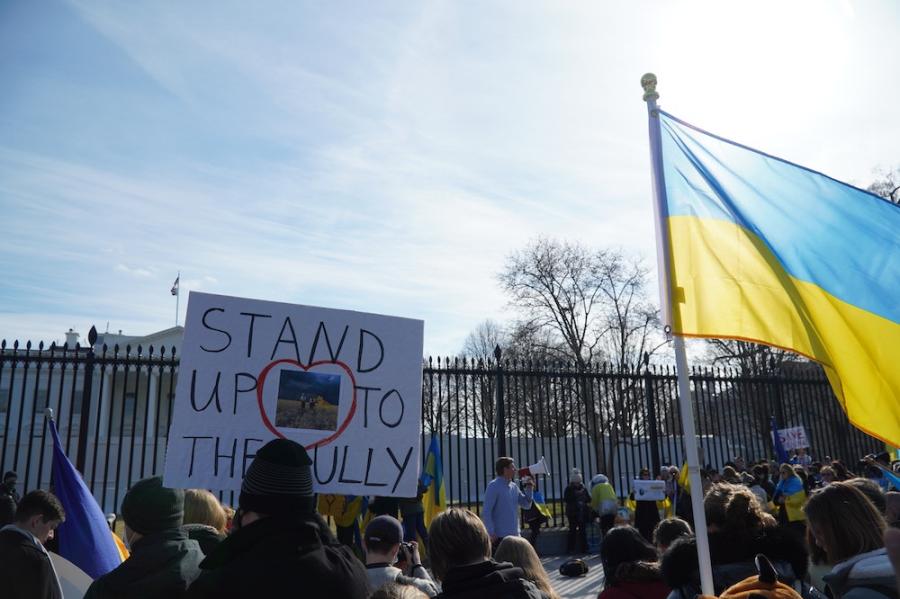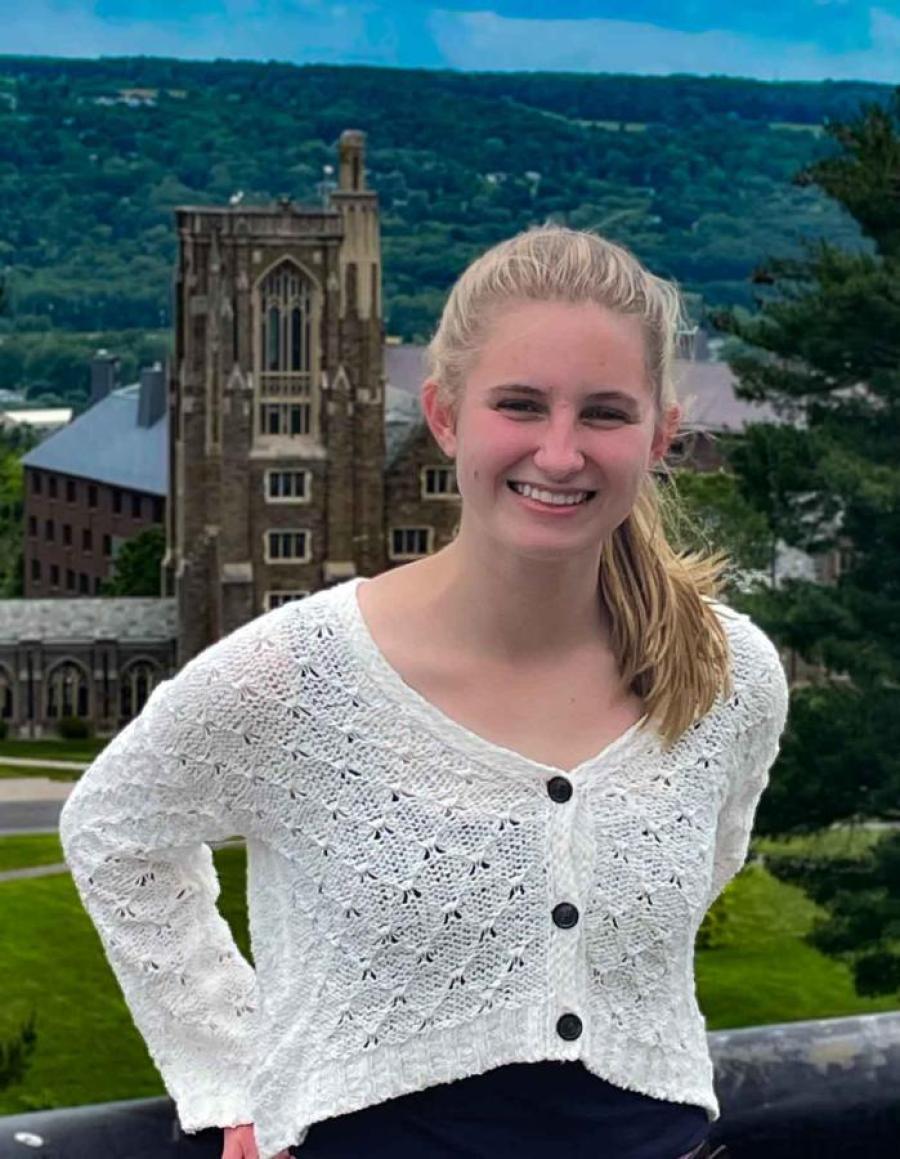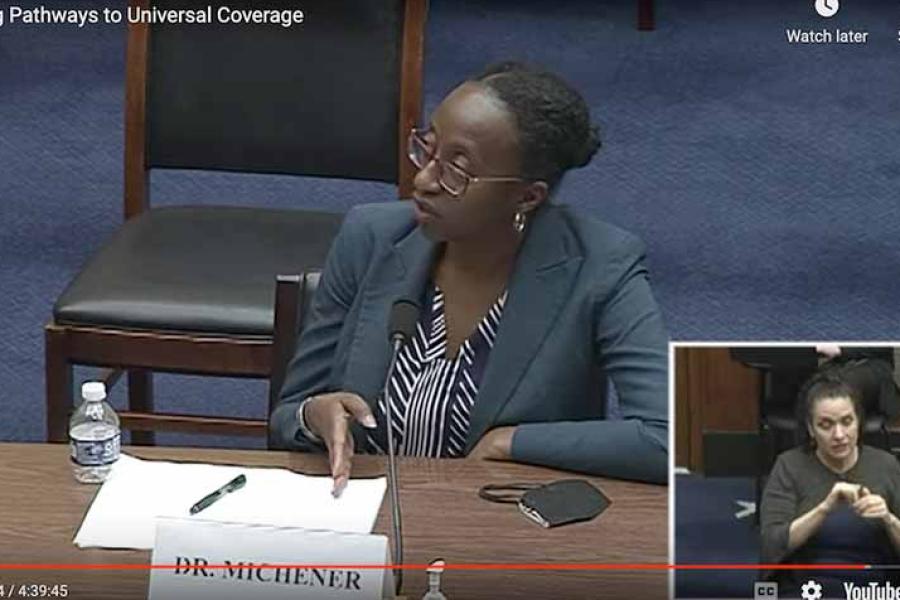
The threat of demographic change may alter who white Americans perceive as racial minorities, potentially making more people vulnerable to discrimination, suggests new Cornell psychology research.
“Resonator” wave guides made of silicon nitride, represented here by gray bars, apply enough force to half-micron-wide plastic beads (blue) to perform a standard biophysical experiment, unzipping DNA molecules held in place by light emanating from the resonator at the point of each bead.
New nanophotonic tweezers developed by Cornell researchers can stretch and unzip DNA molecules as well as disrupt and map protein-DNA interactions, paving the way for commercial availability.
Carla DeMello/Provided
The Nobel Prize awarded to Hans Bethe in 1967
Bethe earned the medal for his theory on the energy production of stars. It now holds a special place in the library among the physicist's papers from his 60-year teaching career at Cornell.
Yale Center for British Art, Paul Mellon Collection
A watercolor ‘view’ by British artist John Thomas Serres (1759–1825) showing the South Foreland and Shakespeare's Cliff.
Watercolor 'views' of enemy coastline, commissioned by the eighteenth century British Royal Navy, are both art and navigational tool, writes Kelly Presutti.
Photo by kremlin.ru/Creative Commons license 3.0
Vladmir Putin and Joe Biden at the 2021 Russia–United States summit
The intimacy of domestic space was a crucial aspect of LGBTQ life in the postwar era, according to historian Stephen Vider, who explores that history in his new book.
Provided
A centrifugal concentrator tube containing purified GluER T36A enzyme. Its yellow color comes from the presence of the flavin cofactor within the enzyme, essential for its function.
Launched in 2019, the institute (known as IOPGA for short) aims to help develop and nurture the next generation of public servants, offering programs that delve into complex issues and events, stress bipartisanship, and raise understanding of domestic and international affairs.
David Rassmussen
Larison in the Rocky Mountains on his first assignment for National Geographic in the early 1980s.
Two recent papers by Owen Marshall uncover the technological practices that brought human speech and insect feeding behavior under electro-acoustic control in the mid-20th century.
Economic sanctions have long been considered a nonviolent deterrent, but ironically they have become a tool of modern warfare, according to a new book by Nicholas Mulder, assistant professor of history.
With a little twist and the turn of a voltage knob, Cornell researchers have shown that a single material system can toggle between two of the wildest states in condensed matter physics.
From teaching food science at the Ithaca Farmers Market to researching how youth feel about their race and ethnicity, this year’s Engaged Faculty Fellows are demonstrating the range of work that’s possible through community-engaged learning and research. The 2021-22 cohorts include 15 faculty from eight Cornell schools and colleges.