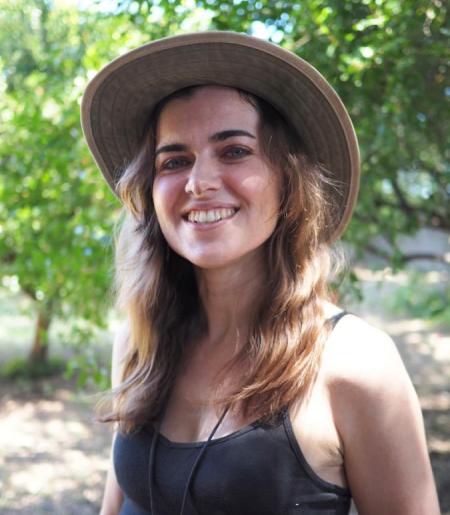
Madineh Sedigh-Sarvestani, who will join the College of Arts and Sciences in July as an assistant professor in the Department of Neurobiology and Behavior.
Sreang Hok/Cornell University
Corey Earle teaches in spring 2023
Three students and a recent graduate have won national scholarships that will prepare them for future global leadership and careers in STEM and public service.
A&S physicist Michelle Wang is among four Cornell faculty who were elected in recognition of their distinguished and continuing achievements in research.
Ideology in China is itself malleable, rather than a rigid cage that determines policy, government professor Jessica Chen Weiss writes in a New York Times opinion.
Cornell's international music festival welcomes longtime friends and new collaborators for five world-class concerts May 19-23.
NASA/CXC/SAO/IXPE
This image of the supernova remnant Cassiopeia A, the first object observed by NASA’s Imaging X-ray Polarimetry Explorer (IXPE) satellite, combines some of the first X-ray data collected by IXPE, shown in magenta, with high-energy X-ray data from NASA’s Chandra X-Ray Observatory, in blue. The satellite later detected polarized X-rays from 4U 0142+61, a highly magnetized neutron star located in the Cassiopeia constellation.
Scientists were surprised when a NASA satellite detected that lower- and higher-energy X-rays were polarized differently, with electromagnetic fields oriented at right angles to each other.