Chris Kitchen for Cornell University
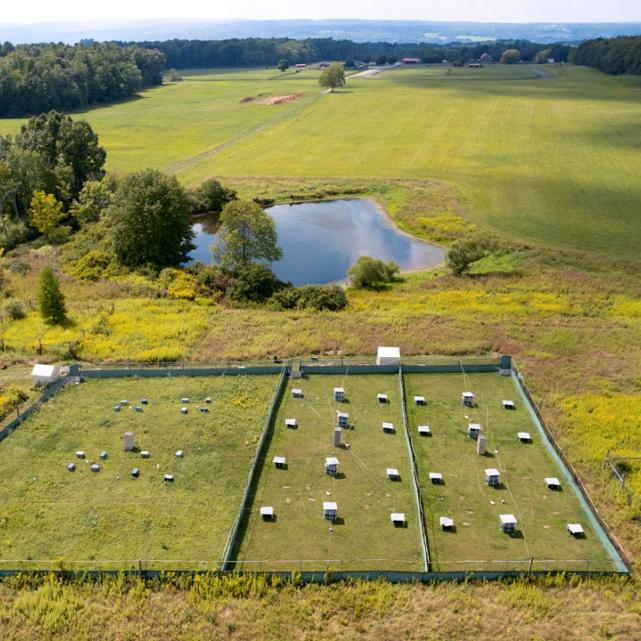
Researchers said enclosed fields, just off Cornell's campus, vastly expand the experiences of lab mice, which have only ever lived in a cage a little larger than a shoebox.
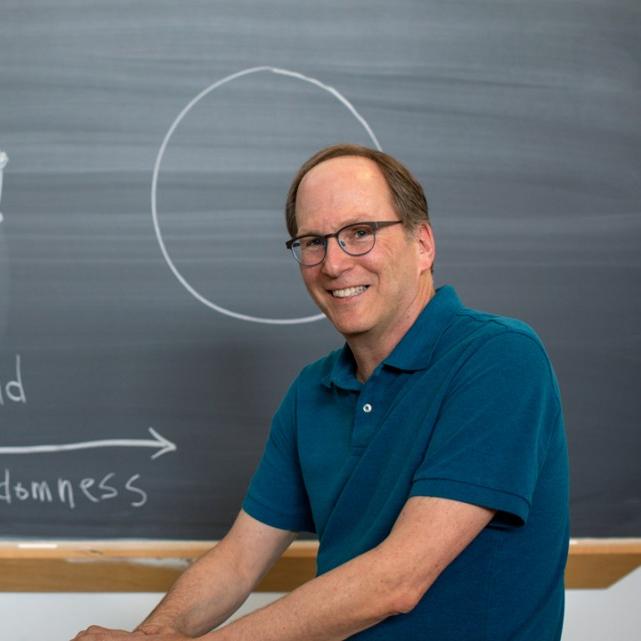
When postdoctoral researcher Matthew Zipple releases lab mice into a large, enclosed field just off Cornell’s campus, something remarkable happens.
Ryan Young/Cornell University
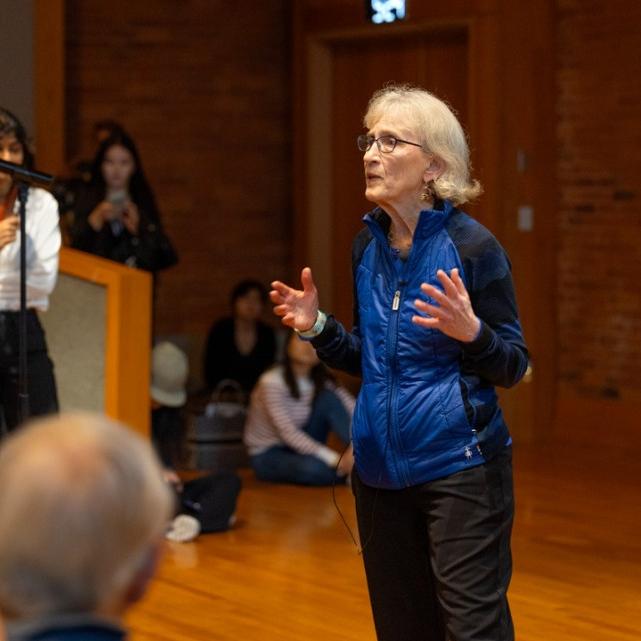
Nobel-winning economist Claudia Goldin '67 delivered the 2025 George Staller Lecture to a packed audience in Rockefeller Hall’s Schwartz Auditorium on Sept. 25.
Claudia Goldin '67 used data to paint a picture of the "tremendous" progress of the U.S. women’s movement, as well as the forces that have prevented women from reaping the benefits of their rights.
Inspired by the mechanisms plants use to store carbon, researchers found that sunlight can power the capture and release of carbon dioxide, which could vastly lower costs and net emissions.
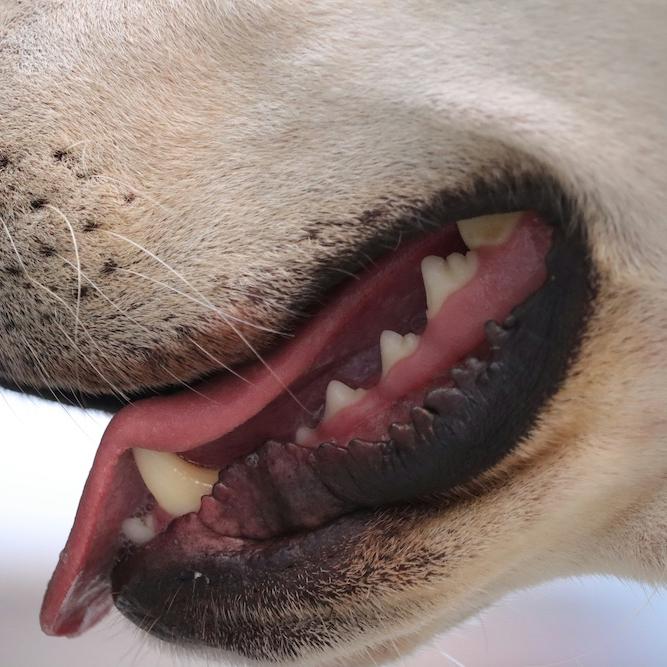
An FDA-approved drug used in humans has been found to inhibit the growth of oral squamous cell carcinomas in dogs - with one dog’s tumor nearly disappearing in a matter of weeks.
Lindsay France/Cornell University
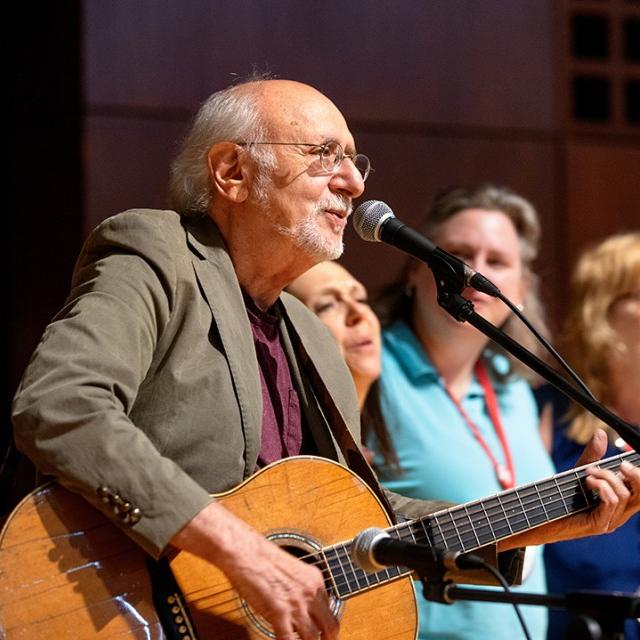
Peter Yarrow ’59 performs in Bailey Hall at Reunion 2019.
Musician Peter Yarrow ’59, who drew early inspiration from his time at Cornell before joining the legendary folk trio Peter, Paul and Mary, died Jan. 7 in Manhattan.
Jason Koski/Cornell University
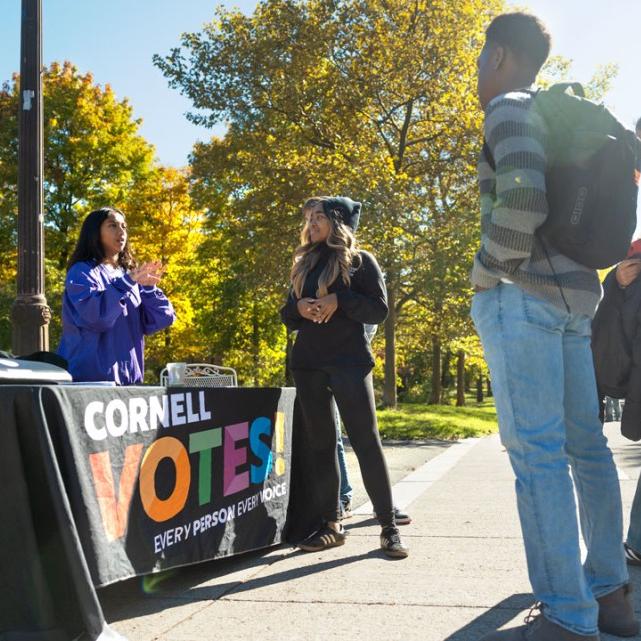
Students from the Cornell Policy Group, a nonpartisan student organization, help others register to vote on Ho Plaza.
Alexis Boyce, program manager for the Asian American Studies Program, has been honored with the Employee Assembly's Award for Staff Inclusion and Integrity.
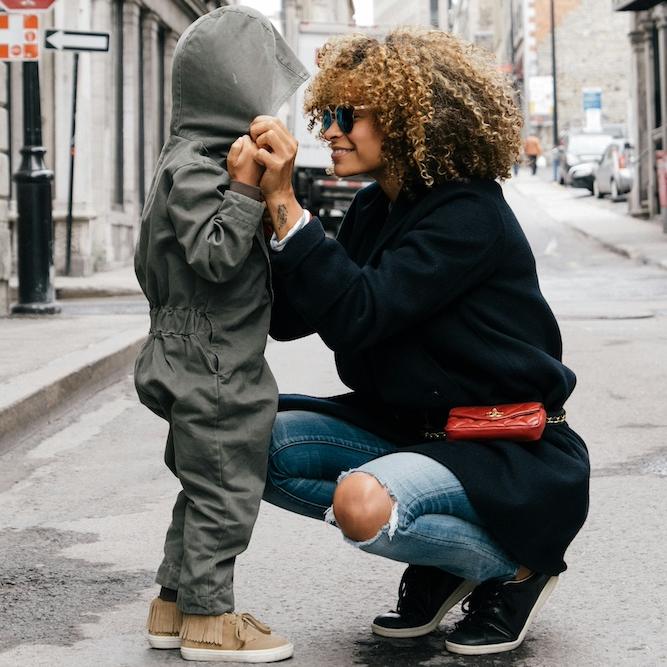
The relationship between mother and child offers clues to the mystery of why humans live longer lives than expected for their size – and sheds new light on what it means to be human.
Noël Heaney/Cornell University
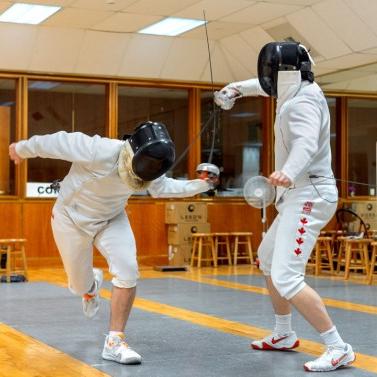
Riley Xian '25 (right), Men's Fencing Club co-captain, led the épéeists to gold at the U.S. Association of Collegiate Fencing Clubs championships on April 13-14.
After rebuilding post-pandemic and with diversity as its strength, the Men’s Fencing Club clinched a surprise win at the 2024 U.S. Association of Collegiate Fencing Clubs championships.
Professor of Africana studies Riché Richardson says reclaiming country music for the Black community and rebranding the genre as an inclusive space are triumphs of Beyoncé’s new album, “Cowboy Carter.”
Jason Koski/Cornell University
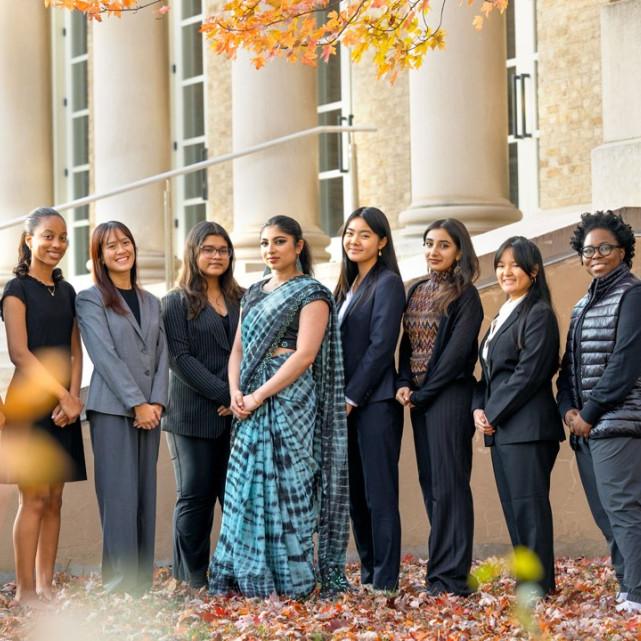
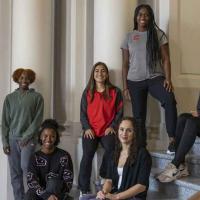
The executive board of Women Leaders of Color, a student group dedicated to uniting and empowering female students of color, outside Kennedy Hall.
After graduating high school, enlisting in the U.S. Army, and nearly finishing his undergraduate studies at Cornell – Andy Shin '23, M.P.A. '25 gained his citizenship last November.
The work, along with a few subsequent papers, ushered in the modern era of network science – the results of which are ubiquitous in today’s world.
Ryan Young/Cornell University
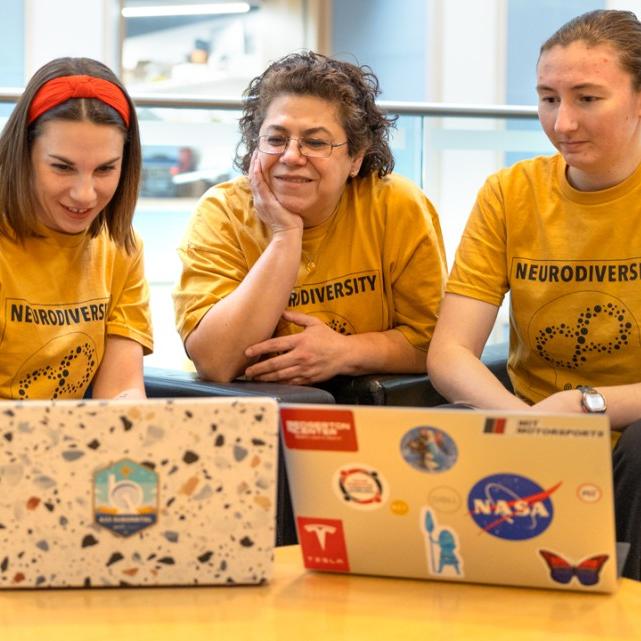
Florencia Ardón (center), founder of Neurodiversity @ Cornell and staff member in the Learning Strategies Center, with neurodiversity ambassadors Carol Anne Barsody M.A. ’23 (left), master’s student in archeology, and Becca McCabe, doctoral student in mechanical engineering, in Duffield Hall
… range of ideas and experiences to enrich campus life together.” … on March 30 of their regular decision acceptance, the official notification date for the Ivy League. An additional … range of ideas and experiences to enrich campus life together.” Students were notified March 30 of their regular …
Ryan Young/Cornell University
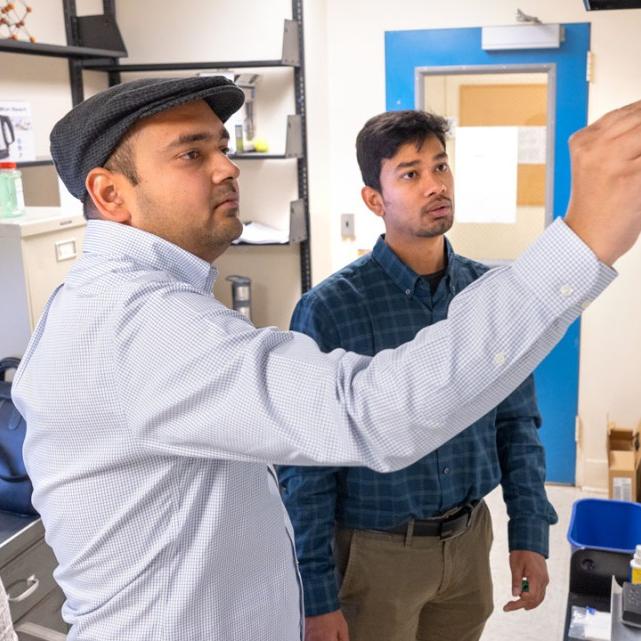
Doctoral student Shikhar Prakash, right, and Madhur Srivastava, assistant research professor in chemistry and chemical biology, work at a white board in the Physical Sciences Building.
The app was inspired by an A&S researcher's own electrical bills.
Ryan Young/Cornell University
Members of the Women of Color Athletes executive board, clockwise from back left, Tia Taylor ’25, track and field; Emily St. John ’23, soccer; Sydney Waiters ’24, soccer; Maddie Packer ’25, track and field; Aviva Muńoz ’23, swimming; and Sydney Moore ’24, volleyball, in Goldwin-Smith Hall. Not pictured: Meilee Key ’24 track and field.
… mentorship and community has been.” WOCA members have also visited with girls of color at a local elementary school; …
Noël Heaney/Cornell University
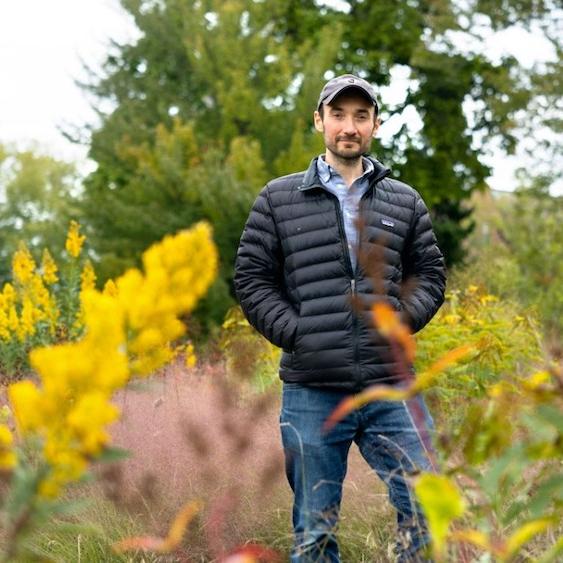
Matthew Dallos, doctoral student in the field of history, designed the Libe Slope Wild Garden for the Biennial, to “insert a moment of wildness” on campus.
The initiative has supported classes in the humanities, the social and natural sciences, mathematics, information science and engineering.
Jason Koski/Cornell University
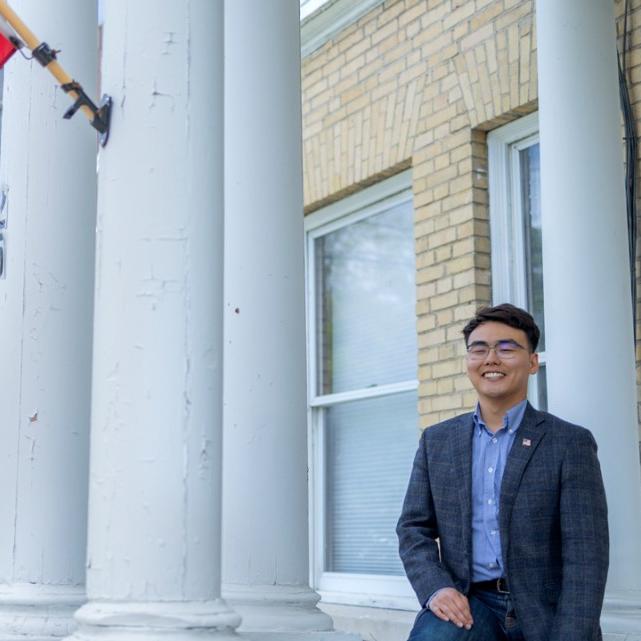
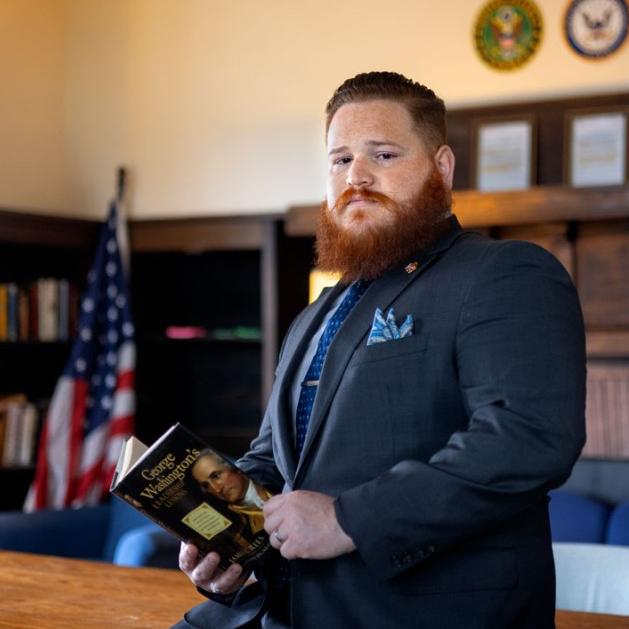
Roland Molina ’22 has dedicated himself to advocating for student veterans and strengthening the veteran community on campus as president of the Cornell Undergraduate Veterans Association.
As a student at Cornell and president of the Cornell Undergraduate Veterans Association, Molina has dedicated himself to strengthening the veteran community on campus.
Big Red Icon is a competition for student bands from across the university that is designed to help rebuild, uplift and connect musicians from all musical traditions. Winners will be given an opportunity to perform at Slope Day Events.
Teaching at Cornell is in the midst of a transformation, with faculty applying the latest research and technologies across disciplines to excite and engage students.
Cornell has entered the second semester of its transition from Blackboard to Canvas, with more than half of all courses now using the new learning management system. Blackboard will be unavailable after the fall 2019 semester.
The Provost’s Seminar on Teaching and Learning brought nearly 75 faculty and instructors together to share and celebrate innovations in teaching at Cornell.
This Cornell Research story focuses on Bach scholar and accomplished organist/pianist, David Yearsley, who is exploring not only Bach’s music but also the music of Bach’s wife and their world.
This Cornell Research story focuses on the work of Rong Ye, one of the first Cornell Presidential Postdoctoral Fellows, who is working in the Department of Chemistry and Chemical Biology.
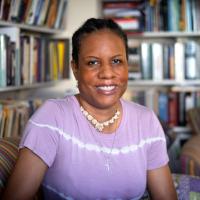
When Carole Boyce Davies, professor of Africana studies and English, first began studying African and African diaspora literature and culture, the field was dominated by male scholars and writers—both as teachers and subjects of study, according to this story on the Cornell Resarch website. Boyce Davies arrived at just the right moment to make significant contributions.
In the middle of the periodic table of elements, on the block that bridges the two jutting sides, is a series of elements known as transition metals. The electronic composition of transition metals makes them great catalysts for some of earth’s most life-enabling reactions. They mediate key reactions, for example, in photosynthesis and help convert nitrogen in the atmosphere so it can be used as a nutrient to sustain life.
Like human social behavior, the behavior of electrons in relation to each other is difficult to predict. In strongly correlated systems, each electron impacts how those around it act, their orientation and movement, and this leads to diverse behavior in the whole. This Cornell Research story explores this behavior.
In 1989, W.E. Moerner—a Cornell University graduate and current professor at Stanford University—discovered a method that allowed researchers to see single molecules for the first time. It was a breakthrough that opened doors for the development of an entirely new technique that would impact scientific research across disciplines, and one that earned Moerner, as well as fellow Cornell alumnus Eric Betzig (Howard Hughes Medical Institute), a Nobel Prize in 2014.
This Cornell Research story focuses on Kim Weeden, the Jan Rock Zubrow ’77 Professor of the Social Sciences and director of the Center for the Study of Inequality, whose work focuses on inequality and opportunity in the United States and other industrialized countries.
Through his writing, archaeology, and outreach, Kurt Jordan, associate professor of anthropology, works alongside Native partners to better understand the indigenous history of the Finger Lakes region.
The research of Richard W. Miller, professor of philosophy and director of the Program on Ethics & Public Life, is explored in this recent Cornell Research story.
Paul A. Fleming, German Studies/Comparative Literature, recounts an old story that’s been told and retold many times. It comes from Herodotus’ Histories, an account of the Egyptian King Psammetichus’ capture by the Persians. As part of the king’s humiliation, the Persians parade his family in front of him—first his daughter as a slave and then his son on his way to execution. While everyone else around him wails, King Psammetichus shows no emotion until a beggared old drinking buddy passes, upon which he begins to weep and lament.
Like all researchers, Itai Cohen, Physics, has a lot of questions. But unlike many, his questions make big, topical leaps. From fruit flies to mosh pits, from origami to cartilage—Cohen dreams of preventing stampedes in Mecca, understanding the complex neuromechanics of fruit fly flight, and making self-folding robots from a single sheet of atoms. How can all this happen in one lab? Well, the answer is: it doesn’t.
Walk by a bakery, and you’ll smell fresh-baked bread. But would you smell it, if you’d never learned what bread was? “Not necessarily,” says Thomas A. Cleland, Psychology.