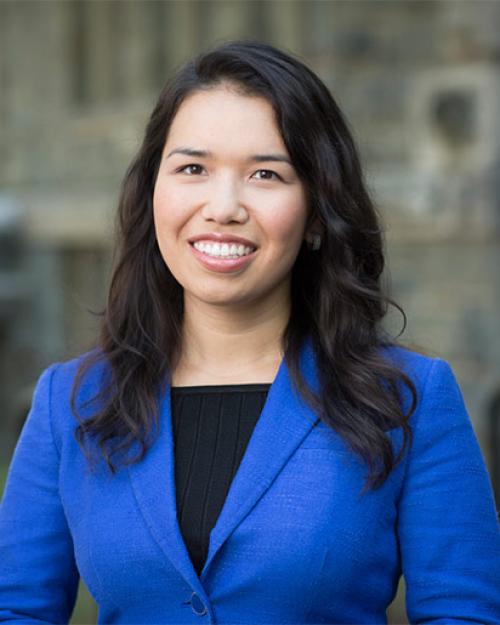
In this Washington Post opinion piece, Jessica Chen Weiss, associate professor of government, and David. A Lake, professor of political science at the University of California at San Diego, discuss the recent trade war that the Trump Administration has instigated with China.
Although Trump hoped for a quick capitualtion to the United States' wishes, the months are dragging on without resolution, the authors write, as they discuss the future of the trade war.
"Even if the United States 'wins' the trade war in the short term with China, making some concessions that allow Trump to declare victory, the United States is likely to lose over the longer term as China works to reduce its dependence on the U.S. market and upgrade its technological capacity," they write.
Simon Wheeler, Cornell University
Cornell Provost Kavita Bala speaking with Kalaniyot Sabbatical Scholar Naomi Havron at the Kalaniyot reception Oct. 19. In the background, Kalaniyot Fellow Eden Eran Nagar speaks with Fellow Shachar Yerushalmi.
Ryan Young/Cornell University
Seidenberger built Hopper from scratch so students can see the logic on which it is built and play a role in developing it and improving it over the course of his class.