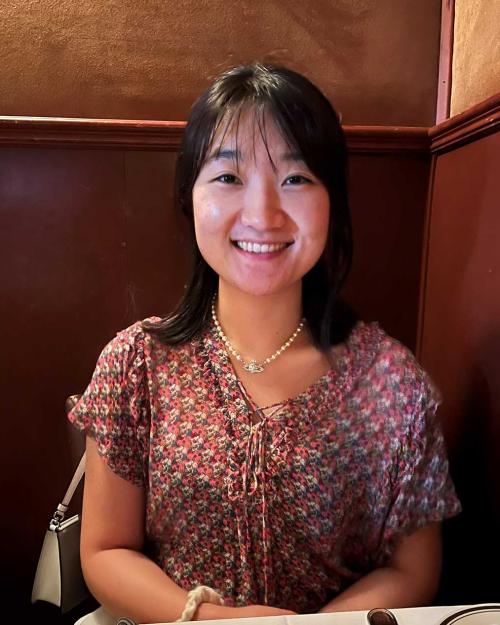
Salimata Cisse
American Studies and Africana Studies
Harlem, N.Y.
Why did you choose Cornell?

I was fortunate enough to visit Cornell during my senior year of high school. My cousin was a student at the time, and she gave me a tour of campus. She showed me more than just the typical spots; she took me to the spaces that truly shape student life. I sat in on club meetings and gatherings, and had the opportunity to experience Cornell beyond its academic reputation.
Before my visit, I knew Cornell was a rigorous institution where I would receive a valuable education. But what stood out to me was what I believe to be the heart of Cornell, the community. In those meetings, I saw that no matter who you are or what you are interested in, there is a space for you here. I left knowing that I would be able to find my people at Cornell, and I have.
What was your favorite class and why?
As a double major, I have had the opportunity to take a number of interesting courses at Cornell. My favorite course was a seminar taught by Dr. Riché Richardson, chair of the Africana Studies and Research Center. The course was entitled ASRC 4212: Writing HERstory and focused on Black women’s autobiographies throughout the 21st century. Each week, we explored a different memoir, including works by Kamala Harris, Viola Davis and Brittney Griner. Beyond reading, the course encouraged deep personal reflection through projects like writing our own autobiographies and conducting a family oral history. It was the first time I experienced true self-reflection in an academic setting, and I found it deeply transformative.
What have you accomplished as a Cornell student that you are most proud of?
As a Nexus Scholar, I was able to conduct research on democratic backsliding and resistance. Through the project, I worked under Professor Rachel Beatty Riedl and Paul Eastburg Friesen in Cornell’s Center on Global Democracy to update a database tracking global attacks on democratic institutions and the responses of both state and non-state actors.
I was able to work specifically on Sub-Saharan Africa, a region deeply important to me. I have continued with the CDG as a fellow this past year, and as someone interested in policy impact, it has been rewarding to work on a project with real-world implications for understanding and strengthening democratic systems.
How have your beliefs or perspectives changed since you first arrived at Cornell?

Since arriving at Cornell, I have come to see the world as far more expansive and complex than I once imagined. Coming from New York City, I had not fully realized how much my perspective had been shaped by the spaces I grew up in.
At Cornell, I was suddenly surrounded by people with such different experiences and backgrounds, which pushed me to reflect on my own understanding of the world. Some of my most meaningful moments here have come from difficult conversations and moments of discomfort where I had to sit with ideas that challenged my own. Here, I learned that growth is not always easy, but it is always worth it.
Every year, our faculty nominate graduating Arts & Sciences students to be featured as part of our Extraordinary Journeys series. Read more about the Class of 2026.
More News from A&S