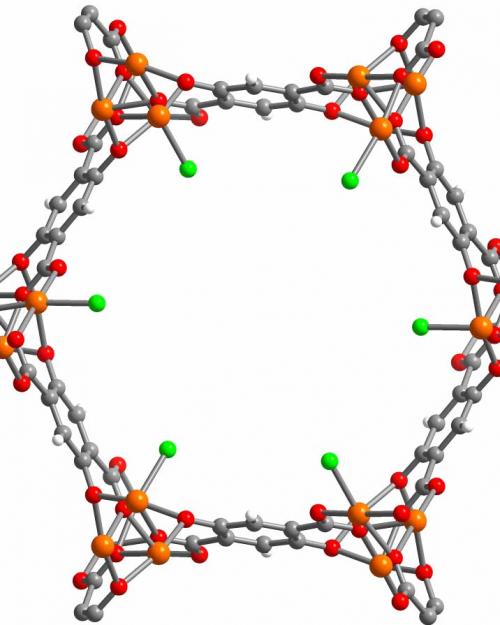
With support from the National Institutes of Health, Phillip J. Milner, assistant professor of chemistry and chemical biology, is developing metal-organic frameworks—a class of porous, crystalline nanomaterials—that can stabilize volatile fluorine-containing reagents, according to Cornell Research.
“This research aims to open up new avenues in the synthesis of biologically active molecules and, more broadly, to demonstrate the unrealized potential of porous nanomaterials in medicine and human health,” says the Cornell Research article. “By taming the reactivity of fluorinated building blocks, this research could enable the preparation of previously inaccessible fluorinated compounds and their evaluation as next-generation medicines.”
Read the story on the Cornell Research website.
More News from A&S


Soprano Dawn Upshaw visits campus as A.D. White Professor-at-Large
A.D. White Professors at Large
A&S Career Development gets facelift, joins new collaborations across campus
Career development