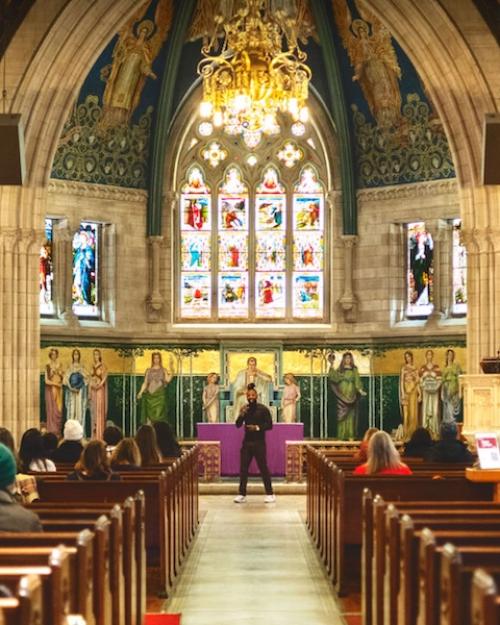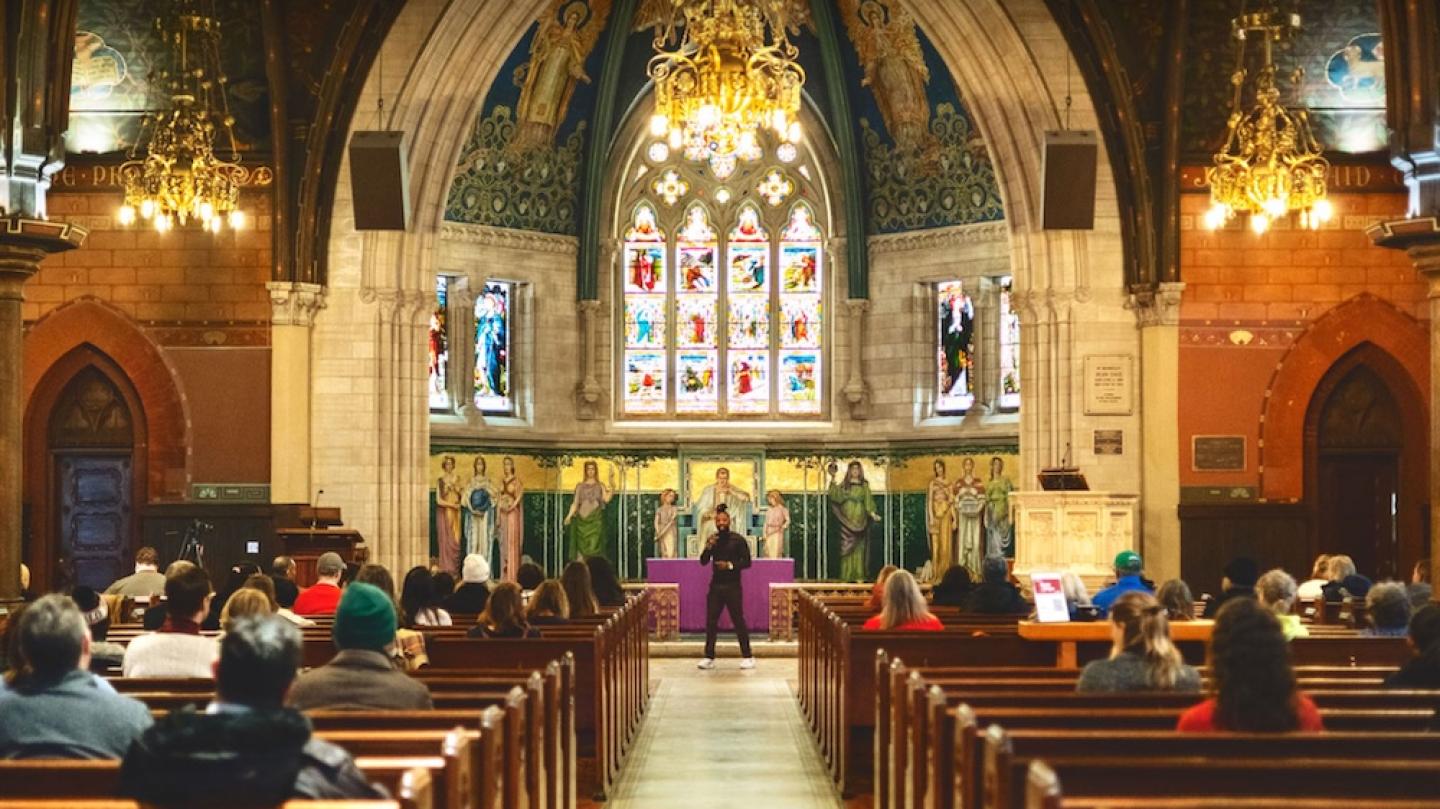
While 2025 saw the celebration of Willard Straight Hall’s centennial, another building milestone went largely unobserved: the 150th anniversary of Sage Chapel.
For a century and a half, the chapel has played a unique role at a nonsectarian institution, offering a spiritual home for generations of Cornellians.
In its earliest years, Cornell had faced withering attacks from clergy and the media for its nonsectarian founding, which was unusual at a time when religion was a major force in higher education. Faculty were accused of atheism—and the fact that students weren’t required to attend chapel services was considered evidence of the new university’s sacrilegious ways.
In his writings and public remarks, founding president Andrew Dickson White often attempted to clarify that nonsectarianism did not equate to an un-Christian philosophy. “We will labor to make this a Christian institution,” he said in his inaugural address. “A sectarian institution may it never be.”
Amid attacks by denominational forces, trustee Henry Sage offered to fund a chapel four years after Cornell opened; the first professor of architecture, Charles Babcock, was commissioned to design it.
Constructed of brick instead of stone, the building cost only $30,000, less than half of Morrill Hall and about one quarter of McGraw Hall. Sage Chapel officially opened on Sunday, June 13, 1875, four days before the University’s seventh Commencement.
Read the full story on the Cornellians website.
More News from A&S

Cute robots, historical chatbots: AI in the classroom grows more sophisticated
Artificial intelligence
Society for the Humanities Fellows to Explore “Survival” at Fall Conference
Society for the Humanities