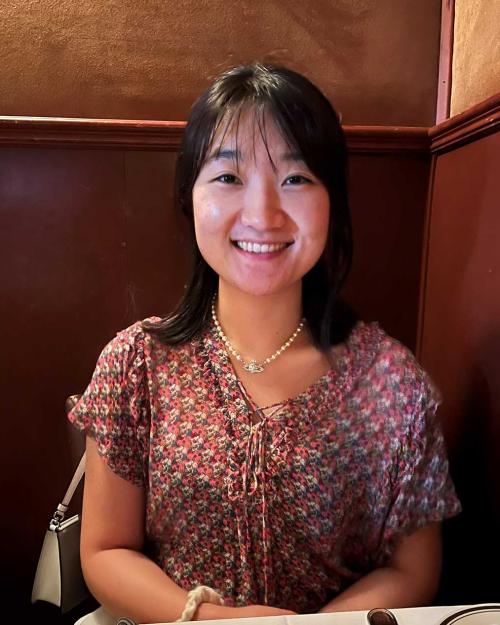
Caroline Smiltneks
Economics and Statistics
Arlington, Va.
What was your favorite class and why?
While it’s difficult to choose my favorite class, the core economics sequence (probability and statistics, econometrics and the micro and macro theory courses) was definitely the most formative.
Those courses allowed me to develop a comprehensive foundation for further study and build a strong mental framework for examining the world through an economic lens (they also taught me academic grit!). Taking the two classes in statistics and econometrics with Professor Doug McKee, I understood the extent to which economics, despite being initially rooted more in philosophy and political theory, is today a highly technical discipline, and the importance of good quantitative analysis in contributing to sound policy choices.
Microeconomics, in turn, showed me how human decision-making can be formalized using the language of mathematics – Professor McKee also showed us when and how models fail, and why elegant mathematics alone is insufficient in a social science discipline (funny enough, people dislike being constrained by economists' equations).
Finally, the course in macroeconomic theory has proven invaluable for interpreting headlines and connecting the dots of how various actions by states, corporations and individuals all link together, and ignited a passion that has shaped my plans for after university.
The sequence armed me with the skills and context to begin thinking about the world like an economist, and has made me appreciate what a powerful toolkit economics provides for making sense of the messy, fascinating and unpredictable world around us.
What is your main extracurricular activity and why is it important to you?
Since my first year at Cornell, I’ve been fortunate to conduct research in economics and finance with Professor Eswar Prasad. Working closely with an outstanding economist at the forefront of his field (and an equally committed mentor) has fundamentally changed how I think about economics as a discipline.
From constructing indexes on the global economic recovery for a think tank to working on a multiyear project examining the evolving dynamics of stablecoins (a type of digital currency pegged to the U.S. dollar), my experience as an undergraduate researcher has given me invaluable insight into how the concepts I encountered in my coursework translate into findings used by academics, policymakers and investors.
If in class I learned about how economic theory works, through research I learned when and why it doesn’t – and how theory and pragmatism go hand in hand in the quest for understanding.
Research is exciting precisely because it is so challenging – unlike in lecture, little is known for certain, and it’s up to you (with the help of your mentors) to find a way forward. Digging through data to uncover trends in macroeconomic activity, writing scripts to analyze cryptocurrency flows and sifting through the academic literature has given me a strong sense that economics is not some abstract science, but rather a very concrete way of dissecting how society operates.
Being deeply involved in research has greatly enriched my studies at Cornell, and has pushed me to become creative, adaptable and much more comfortable with the unknown.
What Cornell memory do you treasure the most?

My time at Cornell was not a collection of disparate moments, but rather a rich and deeply meaningful period full of unforgettable memories, many of them simple everyday experiences.
From laughing with friends over the clever wording of a homework assignment (and the fact that we probably should’ve started it earlier), to stopping by a professor’s office hours only to discover that they are just as human as you and me (just much more knowledgeable in their subject), to wandering out of Uris Library after a late-night study session and taking in the view of nighttime Ithaca from the overlook, the last four years have been memorable not only in their extraordinary moments but in the beautiful continuum of learning, reflection and connection.
What have you accomplished as a Cornell student that you are most proud of?
To pick just one of the many opportunities I’ve been lucky to have, my junior year abroad at Pembroke College, University of Oxford, was an incredible part of my time as a university student and a source of profound growth.
At Cornell, most courses are taught through a combination of lectures and discussions; at Oxford, teaching is typically done two-on-one with your professors in a Socratic-style discussion called a tutorial. Being tasked with not just writing an essay or solving a problem set (or a “problem sheet,” as the Brits call it) but also defending every decision I made in front of my teachers trained me to be meticulous in my thinking, a habit that I’m sure will serve me well far beyond university.

Outside of academics, a year living side by side with full-time Oxford students in a college environment, attending weekly banquets at Pembroke’s centuries-old hall, and spending hours in conversation (and many games of lawn croquet) with students and researchers from all corners of the world instilled a sharper recognition of how integral a diversity of experiences, cultures and perspectives is to deep academic pursuit.
My time in the U.K. gave me a wealth of new experiences and fresh ideas, a trans-Atlantic community of excellent friends and a strong sense of respect for the traditional system of British higher education. (It also fostered a love for afternoon tea and British humor.) I returned to Cornell for my senior year with a deeper appreciation for the distinguishing facets of the liberal arts curriculum and a mindset of adaptability, both of which have made my final year here all the more enjoyable.
If you were to offer advice to an incoming first-year student, what would you say?
Learn to embrace failure. That doesn’t sound very optimistic, but I promise that it is!

College is a unique four years, where you are exposed to so many new and possibly scary opportunities and at the same time shielded from the consequences of true failure.
Don’t know anything about finance and want to apply to that finance club? Apply anyway! Want to try modern dance but you have the coordination of a panda? Still show up to the audition!
Messing up in small ways in college trains you to tolerate being bad at something without letting it derail you, and makes you more resilient for the times in the future when the stakes become real. And if you make peace with occasionally failing, you’re much more likely to take risks that lead to opportunities you never would have encountered otherwise. Learning to put myself out there and being OK with knowing that sometimes I won’t achieve exactly what I was hoping for has made my time here much richer – I hope the same will be true for you.
What are your plans for next year?
After graduating, I’ll be following my interest in economics and markets into practice, working at Goldman Sachs as a foreign exchange options trading analyst.
Every year, our faculty nominate graduating Arts & Sciences students to be featured as part of our Extraordinary Journeys series. Read more about the Class of 2026.
More News from A&S