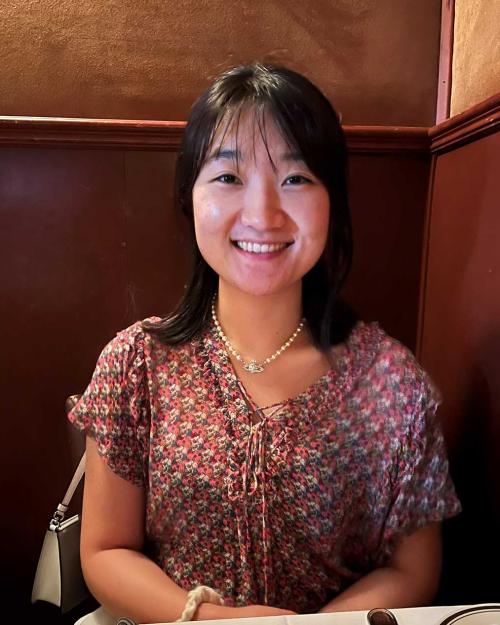
Gabriella Best
Computer Science
Seattle, Wash.
What was your favorite class and why?
I really enjoyed GOVT 1817: Making Sense of World Politics with Professor Peter Katzenstein. He would host biweekly required lab meetings outside of class and around 50 students would pile into a small classroom and listen.
He would start by telling us that we could ask him anything, and we did. One memorable meeting was right after the start of the Israel-Gaza war when tensions were high. Not only did he keep order in a room with people of every viewpoint, but he also supervised one of the most open and productive conversations about the war that I have seen.
I enjoyed Professor Katzenstein’s class because he helped me restructure my thinking to better understand the multidimensional nature of the world and approach complex disagreements with the willingness to change my own mind.
What is your main extracurricular activity and why is it important to you?

The Cornell Rocketry Team has been one of the most important extracurricular activities for me. They are one of the most hard working groups of people I have ever met, and they continue to push me to do better every day.
On our team, there is no such thing as failure, only another opportunity to learn. My first year on the team, our rocket’s parachute didn’t open and instead plummeted 10,000 feet. Instead of calling it quits, the team inspected the crash zone like a crime scene, working together to figure out what went wrong. In the span of two weeks, the team rebuilt the entire rocket. It completely changed how I viewed success going forward.
Since then, I have seen three more rockets crash. I have weathered tornadoes and snowstorms while in the field. I have watched a project I had been working on for two years break down the night before a launch. Despite all of this, I find myself always coming back. And I come back stronger. Because every failed test, every parachute that didn’t come out, and every rocket that smashed into pieces when it hit the ground eventually made our team stronger.
The ability to try, fail, and try over and over again is something I learned while on this team and that will stay with me long after I graduate from Cornell.
Who or what influenced your Cornell education the most?
The Milstein Program has been one of the single most influential aspects of my time at Cornell, enabling me to pursue experiences completely outside the box.
During my freshman year, I had the opportunity to interview students from all over the world about their experiences during the COVID-19 pandemic. That summer at Cornell Tech, I found a sense of belonging among my fellow Milstein scholars as we explored New York City and pursued projects centered around community.

The summer following my sophomore year, the program helped sponsor my research abroad in Taiwan, providing guidance on how to conduct and report on conversations with industry leaders. During my junior year, the program helped me to attend the Grace Hopper Celebration in Philadelphia, a conference dedicated to supporting women in technology fields, that really helped kickstart my career journey. I also attended the International Astronautical Congress in Milan, a conference that brings together space leaders in industry, government and academia from around the world to discuss and showcase the latest innovations.
After spending the year developing a synthetic data and machine learning pipeline to track wasp movements, I presented my work at the Milstein Expo, showcasing what I had learned to my Milstein peers and greater Cornell community.
At every step of my Cornell journey, the Milstein Program has been there. I cannot be more grateful to the students and faculty who completely transformed my Cornell experience and helped me grow into the person I am today.
If you were to offer advice to an incoming first-year student, what would you say?

I think it’s easy to get caught up in the paths we’re “supposed to take.” I have come to realize that passion is what created the foundation of my success, and support from the Cornell community has given me the ability to achieve it.
Over the years, many people asked me: “Why did you spend so much time studying Chinese?” “Why did you spend so many weekends in a corn field trying to launch a rocket that would probably crash?” “Why did you take so many classes in the government, information science and public policy departments?” “Why did you join an animal behavior lab?” “Why did you join an architecture lab?” “Why spend all this time and do all these things that don’t seem to have any relevance to your major or future career?”
While on the surface these experiences seem disconnected, underneath they came together to create opportunities I never thought possible. Every software engineering interview I’ve had has prompted me to discuss at least one of the above, something I never would’ve expected. Even opportunities within Cornell have opened up because of seemingly unrelated experiences.
My advice to an incoming first year student would be to open yourself up to new experiences and try everything that interests you. You never know what may come out of it.
What are your plans for next year?
I will be working at Oracle, within the Oracle Cloud Infrastructure (OCI) branch, as a software engineer in Seattle, Wash.
Every year, our faculty nominate graduating Arts & Sciences students to be featured as part of our Extraordinary Journeys series. Read more about the Class of 2026.
More News from A&S