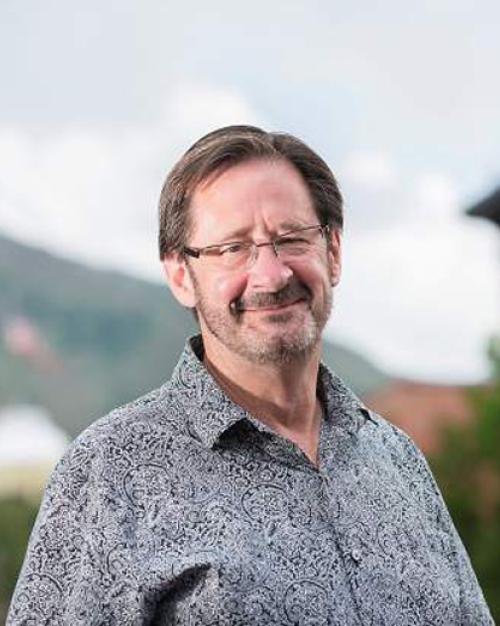
Ten years after the death of Steven Stucky, the Given Foundation Professor of Music Emeritus, the Department of Music is honoring the Pulitzer Prize-winning composer and beloved Cornell professor with a series of concerts that highlight both his legacy and the creativity he sparked in generations of students.
Stucky, whose portrait hangs in the atrium of Klarman Hall beside one of Toni Morrison, shaped Cornell’s musical community for more than three decades. The four events honoring him this semester – spanning intimate recitals, premieres and a large Reunion‑weekend concert – reflect the breadth of his influence.
They are organized by his former colleague, pianist and music professor Xak Bjerken, professor of music in the College of Arts and Sciences, who founded Ensemble X with Stucky nearly 30 years ago.
“People may not realize how much Steve gave to Cornell and to our arts community,” Bjerken said. “His touch as a teacher was so gentle, but incredibly effective. His students have gone on to compose in every imaginable style.”
As a composer, Stucky broke new ground by blending modern complexity with sophisticated orchestration, maintaining a long association with the Los Angeles Philharmonic that helped bring modern repertoire to wider audiences. He was awarded the 2005 Pulitzer Prize in Music for his “Second Concerto for Orchestra,” a work Bjerken said blends references to composers from the past with innovations that tailored the piece to specific members of the LA Philharmonic.
This semester’s celebration began Jan. 23 at the A.D. White House with “Their Swan Songs: Schubert and Stucky,” featuring Stucky’s final song for voice and piano, “Out of the Cradle, Endlessly Rocking.” Commissioned two years before Stucky’s death and rarely performed, the piece was inspired by Walt Whitman’s reflections on childhood and memory. The concert paired that piece with songs Franz Schubert wrote in the latter part of his life. Baritone Brian V. Sengdala, a doctoral student in the Department of Performing and Media Arts, performed with Bjerken on piano.
On Feb. 22 at 3 p.m., Ensemble X will present the first of two “Boulangerie” concerts celebrating legendary composer Nadia Boulanger. The program includes works by Lili Boulanger, Philip Glass, Elliott Carter, Walter Piston and Marc Blitzstein, as well as by Igor Santos, assistant professor of music (A&S), and Stucky. The event marks the East Coast premiere of Stucky’s final, unpublished work, “The Music of Light,” written in the last weeks of his life and performed by the Cayuga Vocal Ensemble, directed by Sean Linfors. The concert takes place in Barnes Hall.
“There’s a history of composers writing in C major at the end of their lives as a kind of acceptance and resignation,” Bjerken said of the piece. He tracked down the score through Stucky’s publisher, since it has never been formally released.
During Mayfest, Cornell will premiere a piano quintet by Joseph Phibbs, who studied under Stucky at Cornell and wrote the new work in his honor. “You can feel Steve’s influence in the background of Joe’s music,” Bjerken said.
The last event takes place June 6 at 4 p.m. in Sage Chapel: a reunion concert featuring works by Stucky and eight of his former doctoral students, many now prominent composers. Performers include the original members of Ensemble X –Bjerken; clarinetist Richard Faria, professor of music at Ithaca College; violinist Ellen Jewett; and cellist Elizabeth Simkin, professor emerita of music at Ithaca College – joined by collaborators including Miri Yampolsky, senior lecturer in music (A&S); Rachel Schutz; and Guillaume Pirard, music director of the Cayuga Chamber Orchestra.
The program ranges from singer‑songwriter pieces to complex contemporary chamber works, underscoring the aesthetic diversity Stucky championed.
A few movements from one of Fitz Rogers’ pieces, “Breaking,” will be on that program, as well as a piece by composer Sally Lamb, MFA ’95, DMA ’98, and Anna Weesner, DMA ’95.
“Steve introduced me to music that was and remains profoundly important to me, composers I would not have found on my own back then,” said Weesner, the Weiss Professor of Music at the University of Pennsylvania.
Said Lamb: “Steve’s ongoing encouragement helped me gain confidence as a composer, caring less about what others thought of my music, what I ‘should’ be writing, and focusing on my own goals as an artist. He also modeled being supportive of other composers and their work rather than competing with them.”
Until his death, Bjerken said, Stucky remained a champion of new music, contacting orchestra directors or friends to recommend works from new composers.
“Steve changed my life both in how he exposed me to so much great new music, but also in how he modeled a selfless colleague and friend,” Bjerken said. “He’s responsible for commissioning some of what we now consider the great pieces of the last 30 to 40 years.”
Along with these music department events, the Sidney Cox Library of Music and Dance in Lincoln Hall is hosting an exhibit, “Music of the Natural World: Cornell Composers on Nature, Ecology, and Climate” featuring music by current and former Cornell students and faculty, including Stucky’s “Silent Spring” (2011) and “High Water Rising for Wind Ensemble” (2018), by Lamb. That exhibit opens Feb. 20.
More News from A&S

Soprano Dawn Upshaw visits campus as A.D. White Professor-at-Large
A.D. White Professors at Large
A&S Career Development gets facelift, joins new collaborations across campus
Career development