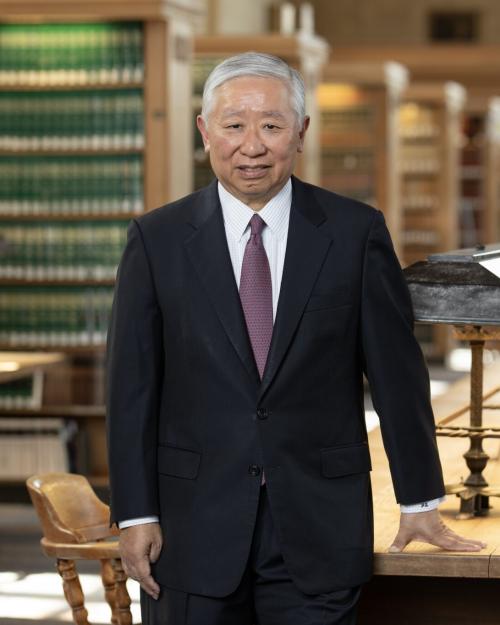
Jonathan Zhu, J.D. ’92, would not have been able to attend Cornell without his A.D. White Fellowship. Initially pursuing study in English literature before eventually switching to law school, Zhu had a difficult time finding funding—an experience familiar to many students in the humanities and humanistic social sciences today.
“I thought, maybe I can do my little bit to help address that,” he said.
In 2021, Zhu and Ruby Ye, M.S. ’90, Ph.D. ’92, established the Zhu Family Graduate Fellowships for doctoral students in the humanities. The fellowships support three students per year and allow them to focus fully on their research. For many students in these fields, doctoral funding comes in the form of a teaching assistantship, which requires a portion of each week to be devoted to teaching-related responsibilities.
“After I graduated, I became involved with Cornell, and I thought about how there are lots of scholarship and research funds, but they tend to be oriented toward the sciences and economics. I felt like maybe the humanities and social sciences, but especially the humanities, don’t seem to be as much of a focus,” Zhu said. “Graduate students in those fields have fewer alternative sources of funding support.”
In addition to wanting to provide more financial opportunities for students in these disciplines, Zhu believes strongly in the importance of a liberal arts education that provides literacy in the traditional sense, as well as ideally also helping students to develop literacies in technology, science, and finances. Establishing the fund felt like one way he could help.
“When I was in the English department, I was studying with M.H. Abrams. One of Abrams’s most important books is ‘The Mirror and the Lamp: Romantic Theory and the Critical Tradition.’ Basically, the idea is that literature is both a mirror reflecting society, but also a lamp that shines a light,” Zhu said. “I keep thinking about liberal education, and I feel like it is supposed to give us the tools for that as well, to give us a mirror and a lamp. That’s why I think humanities are so important.”
Elexis Trinity Williams, a science and technology studies doctoral candidate, is familiar with the search for funding in pursuit of an education in the humanities, which has made them even more appreciative of their selection as a 2025 Zhu Fellow.
“As a first-generation college graduate, I worked several jobs to put myself through college, so I know intimately how challenging it can be to juggle research and scholarship with outside responsibilities,” they said. “It’s made me especially grateful to have been selected for the Zhu Family Graduate Fellowship. I have the freedom to immerse myself fully in my dissertation project, knowing that I have the time and resources to do my best work.”
Each of the three 2025 fellows appreciates that the fellowship’s financial support paired with the release from teaching responsibilities allows them the flexibility to pursue research questions as they arise regardless of where the questions lead them.
“The Zhu Fellowship allows me to fully dedicate myself to work on my dissertation. Since it does not require residency in Ithaca, I moved to Philadelphia for its strategic location and access to museums and libraries relevant to my research, as well as major airports and the Amtrak rail system to travel internationally and go to key institutions in New York City and Washington, D.C.,” said Leonardo Santamaria Montero, a history of art, archaeology, and visual studies doctoral candidate. “This fellowship also gives me greater scheduling flexibility to plan my research travels.”
Similarly, being selected as a Zhu Fellow allowed anthropology doctoral candidate Nia Whitmal to temporarily relocate to New York City, where she was able to move across the street from the Schomburg Center for Research in Black Culture in Harlem—an important site for her research.
“With the funding afforded by the Zhu fellowship, I can spend my time in their archives, supplementing my work on west and central Harlem’s contemporary housing landscape with historical records,” she said.
Williams also appreciates the ability to visit archives, spend entire days writing, and participate in workshops and conferences on her own schedule.
“The Zhu Fellowship has been instrumental in making all of that possible,” they said. “I couldn’t be more grateful.”
Gifts of any amount support graduate students in pursuit of their degrees. Visit Cornell’s Giving website to explore your options.
Read the story on the Cornell University Graduate School website.
More News from A&S
Cornell biologist named Blavatnik Award finalist for work with rewilded mice
Neurobiology and behavior
Cornell mathematicians win grants to ensure AI safety, research integrity
Mathematics
Jazz master Chucho Valdés birthday celebration opens concert series Oct. 23
Music