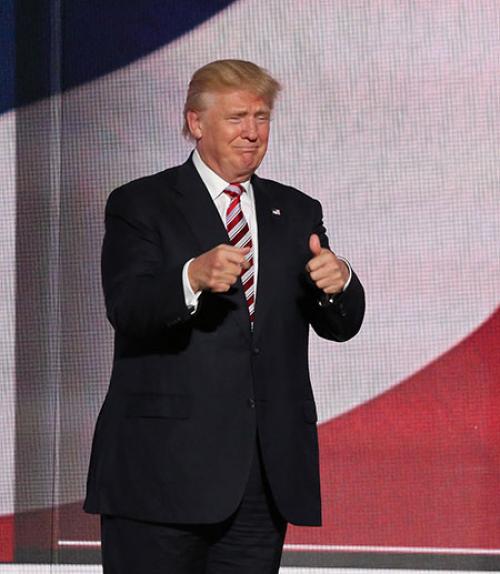
Former President Trump, in a speech to a group of conservative Christians last Friday, told the audience that if they voted for him this year, they wouldn’t need to in the future because in four more years, the election would be fixed. The Harris campaign has called the former president’s words a “vow to end democracy.”
Rachel Beatty Riedl, professor of government and policy at Cornell University, directs the Center on Global Democracy and is an expert on democracy and authoritarianism globally. She says Trump’s rhetoric is clear evidence of an agenda to reject democratic principles.
“The suggestion by former President Trump that supporters would not need to vote in the future, after electing him in 2024, because it would be fixed, can only be interpreted as clear evidence of an agenda to reject democratic principles and electoral alternation," says Riedl.
“Trump’s dangerous assertion that future elections would be irrelevant builds on his continued unwillingness to accept unfavorable results and is consistent with authoritarian rhetoric and practices around the world. Facilitating free and fair elections and accepting electoral defeat are keystones of democracy globally, and mobilizing supporters by any other logic is already assault on democracy itself,” Riedl says.
For interviews contact Damien Sharp, 540-222-8208, drs395@cornell.edu.
More News from A&S

Annetta Alexandridis commemorated through installation, Oct. 31 memorial
History of Art and Visual Studies
Shakespeare’s 'Twelfth Night:' Mad Love, Mad Music
Performing and Media Arts
Pinkham’s ‘The Oak and the Larch’ wins Pushkin House Book Prize
Comparative literature