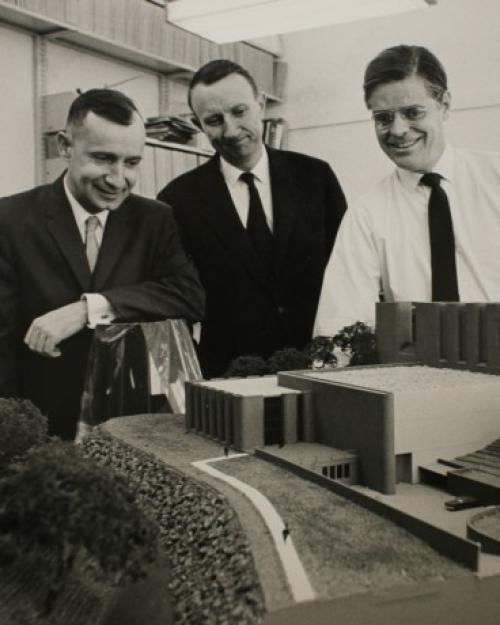
Cornell Cinema will present a free screening of the documentary The Accelerator on Tuesday, April 8, at 6 p.m. Producer David Raubach will attend the screening and participate in a discussion following the film.
The documentary explores the life and impact of Dr. Robert R. Wilson, a pioneering physicist whose legacy is deeply connected to Cornell. Wilson played a key role in the Manhattan Project before shifting his focus to accelerator physics, ultimately designing and overseeing the construction of the Cornell Synchrotron - which bears his name - and Fermilab, the U.S. government’s largest particle physics laboratory. He is also credited as the “Father of Proton Therapy” for his groundbreaking 1946 paper describing how proton beams could be used to treat cancer—an innovation that remains a standard of care at leading cancer centers today.
The Accelerator features never-before-seen footage and interviews with Wilson and the scientists he influenced, as well as archival material from the Manhattan Project. The screening offers a unique opportunity to experience the film before its public release and engage in conversation with its producer.
The screening is sponsored by the Cornell Laboratory for Accelerator-based Sciences and Education (CLASSE).
Watch the trailer for the film at theacceleratorfilm.com.
More News from A&S

Cornell biologist named Blavatnik Award finalist for work with rewilded mice
Neurobiology and behavior
Cornell mathematicians win grants to ensure AI safety, research integrity
Mathematics
Jazz master Chucho Valdés birthday celebration opens concert series Oct. 23
Music