Leaders from the College of Arts & Sciences recently traveled to China and Asia to celebrate the 20th anniversary of the Brittany and Adam J. Levinson Program in China and Asia-Pacific Studies and to join other Cornell delegates at the Cornell-China Forum in Shanghai.
While there, they were also joined by eight Levinson Program students studying abroad at Peking University as part of the program’s experience of an intensive language requirement combined with courses on contemporary China.
“The Levinson Program is a core component of our international engagement with China and the Asia Pacific, and we’re proud it has weathered the uncertainties and challenges of COVID,” said Patrizia McBride, senior associate dean in A&S and Frank H.T. Rhodes Professor of Humane Letters in the Department of German Studies. “Student interest has revived beyond our wildest expectations.”
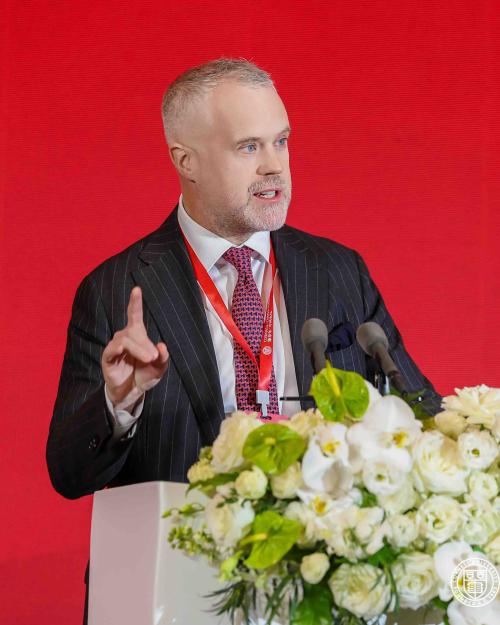
The trip included a roundtable discussion between College leaders, Levinson Program students and alumni, and Adam Levinson ’92, who has offered major support for the program; a speech by Peter John Loewen, the Harold Tanner Dean of Arts & Sciences, celebrating the program’s 20th anniversary at the 2025 Cornell-China Forum; a panel, “Building Bridges: The Past and Future of China and Asia-Pacific Studies at Cornell;” and a “Study China in China” conference, organized by the Levinson Program and Yenching Academy at Peking University, which involved nearly 20 other China-based China studies programs.
Cornell students who major in China and Asia-Pacific Studies take a set of courses on China's language, history, politics, economy, society and foreign relations, including at least six semesters of Chinese language. They also spend one required semester at Peking University in Beijing, China’s most prestigious university. The program began in 2005 thanks to the leadership and $5 million gift from Michael Zak ’75, which endowed a CAPS professorship and provided academic support.
“Living here has made everything I learned in class feel a lot more real,” said Brittany Sun ‘27, an information science and Levinson Program major who’s at Peking University this semester. “We talk about digitalization and supply chains all the time, but it is completely different when you’re actually experiencing it. Especially when scanning QR codes for everything, seeing how public spaces are designed or noticing how quickly cities adapt and change.”
Sun chose to major in China and Asia-Pacific Studies to gain a deeper understanding of the country and culture, but also to reconnect with her own heritage and strengthen her language skills.
“Growing up near Flushing, a Chinatown in Queens, I was surrounded by Chinese culture, but the language often felt distant,” she said. “Over time, I realized it was actually a bridge between my past and future, especially as China becomes increasingly central in global conversations.”
On campus, the Levinson program is in the middle of an international search for a new faculty director. During this trip to China, interim director Xu Xin, who is the Levinson program’s manager and adjunct associate professor in government, and Cathy Hao, the Peking University contact for the program, were honored for their service to the program.
“Students are drawn into the program because of the rigorous and flexible curriculum we offer – with a focus on the study of contemporary China, but tailored to students’ diverse backgrounds, interests and needs,” Xu Xin said.
Loewen said the program is a major part of the College’s engagement on the international stage.
“We are excited to continue to bolster this historical partnership with Peking University as we realize the broad impact the program has had on our faculty and students,” he said. “For Levinson program students, the opportunity to have experiences and learn the language on site in Beijing is vital to their growth as scholars of China and the Asia Pacific and as citizens of the world. And the program has become a hub for academic and policy-related conversations about China and the Asia-Pacific region.”
Sun said her experience this semester has helped solidify her desire to work at the intersection of technology and social impact. And it’s widened her perspective on possible career paths.
“I feel very fortunate to have had this window into a different way of thinking and living as it made me more open-minded about the possibilities ahead,” she said. “It also shifted my understanding of China’s place in the world. Growing up in the U.S., so much of the conversation is framed around tension or competition. Being here lets me see the domestic perspective of how people themselves experienced this growth and how China views its own role globally. That contrast between the U.S. lens and what I experienced on the ground was one of the biggest takeaways of the semester.”
More News from A&S


Soprano Dawn Upshaw visits campus as A.D. White Professor-at-Large
A.D. White Professors at Large
A&S Career Development gets facelift, joins new collaborations across campus
Career development