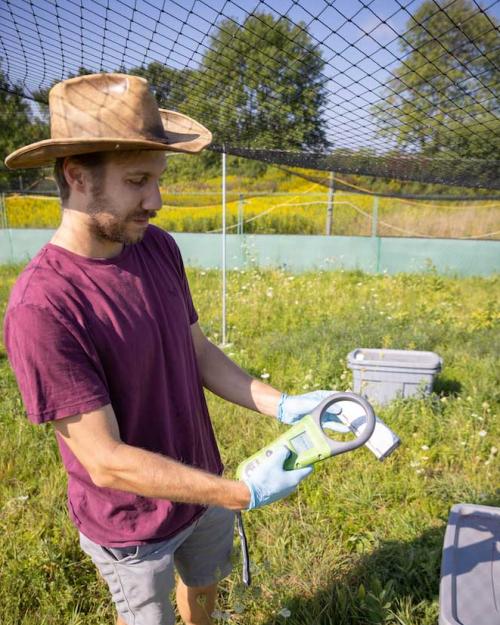
Matthew Zipple, postdoctoral fellow in neurobiology and behavior in the College of Arts and Sciences (A&S) and former Klarman Postdoctoral Fellow, is a finalist for the Blavatnik Regional Award in Life Sciences.
Blavatnik Awards for Postdoctoral Excellence, given each year by the Blavatnik Family Foundation and the New York Academy of Sciences, honor outstanding postdoctoral researchers in physical sciences and engineering, chemical sciences and life sciences. Awardees and finalists were honored on Oct. 6 at the American Museum of Natural History in New York. Finalists in each category receive $10,000 in unrestricted funds.
Zipple won a place as a finalist for his “strikingly different approach” to life science research, the award citation said, “challenging traditional laboratory paradigms by rewilding lab mice to demonstrate how molecular aging, complex emotions and physiology are all influenced by naturalistic environments and social dynamics, a line of research that questions decades of experimental convention in biomedical science.”
As a Klarman Fellow, Zipple introduced ground-breaking methods studying rewilded mice in open-air enclosures instead of cages. Living in an enclosed field just off Cornell’s campus, mice can move freely, burrow and climb, find their own food and navigate weather, seasons and each other.
In lab mice rehomed to fields, anxiety is reversed, he found in a 2025 study.
“The rewilded mice show either no fear response,” to a maze that provokes anxiety in lab mice, “or a much, much weaker response,” Zipple said of that research.
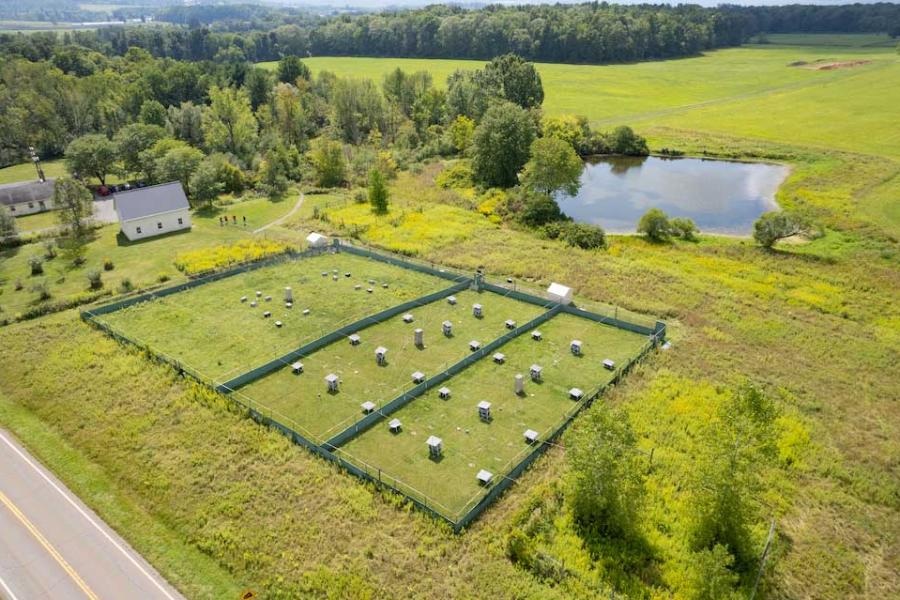
His related studies in the outdoor setting have investigated the effects of early experiences for male mice and the behavior of female mice outdoors. He’s also studied the centrality of maternal care in human longevity and the effects of reduced child mortality on mothers’ lifespans.
“This award emphasizes an uncomfortable truth in biomedicine – that we have very poor models for understanding how the physical and social environment get under the skin to shape individuals’ behavior, health and survival,” Zipple said. “I’m thrilled that a growing group of scientists are working to build a better model organism, based on ecological realism, environmental dynamism and real challenges and opportunities that matter to both non-human animals and humans.”
This year’s honorees were chosen from 176 nominations representing 35 academic and research institutions, “a pool that reflects the extraordinary density of world-class research laboratories concentrated in the New York metropolitan region,” the award citation said.
More News from A&S

Cornell mathematicians win grants to ensure AI safety, research integrity
Mathematics
Jazz master Chucho Valdés birthday celebration opens concert series Oct. 23
Music