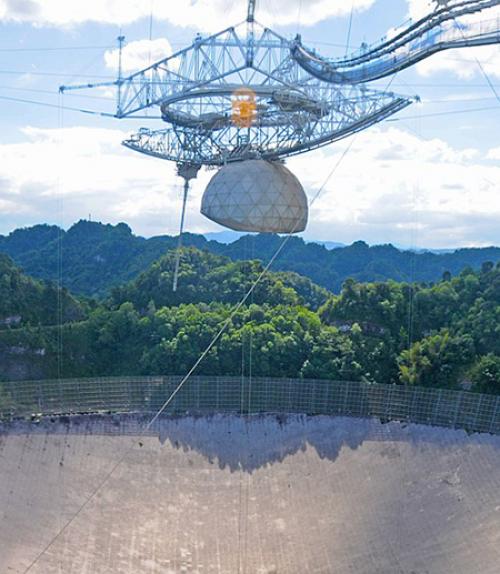
Martha P. Haynes, the Goldwin Smith Professor of astronomy, has earned many awards in her 37-year career at Cornell, an article on the Cornell Research website points out. She even has an asteroid named after her. But what excites her the most these days is the new, groundbreaking telescope she will be leaving behind for the next generation of researchers: the Cerro Chajnantor Atacama Telescope-prime (CCAT-prime), the six-meter (20 feet) diameter telescope situated at 18,400 feet in the Atacama Desert of Chile.
“CCAT-prime is a state-of-the-art frontier telescope that will be unique because of its high site and its very precise mirror,” Haynes explains in the article. “It is designed to observe at short wavelengths—about a third of a millimeter to two millimeters—that are hard to observe on Earth because water vapor molecules in the atmosphere absorb these photons and block them from reaching the ground.”
Read the story on the Cornell Research website.
More News from A&S
Cornell astronomy researcher to head planetary science workforce survey
Astronomy

Francis Fukuyama ’74 named Freedom and Free Societies Professor
Freedom and Free Societies