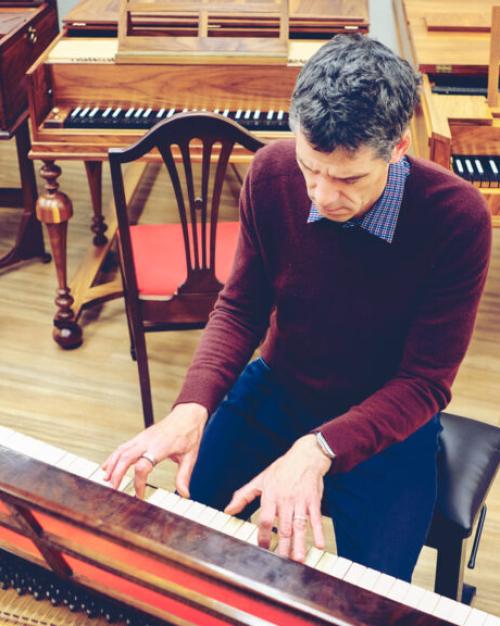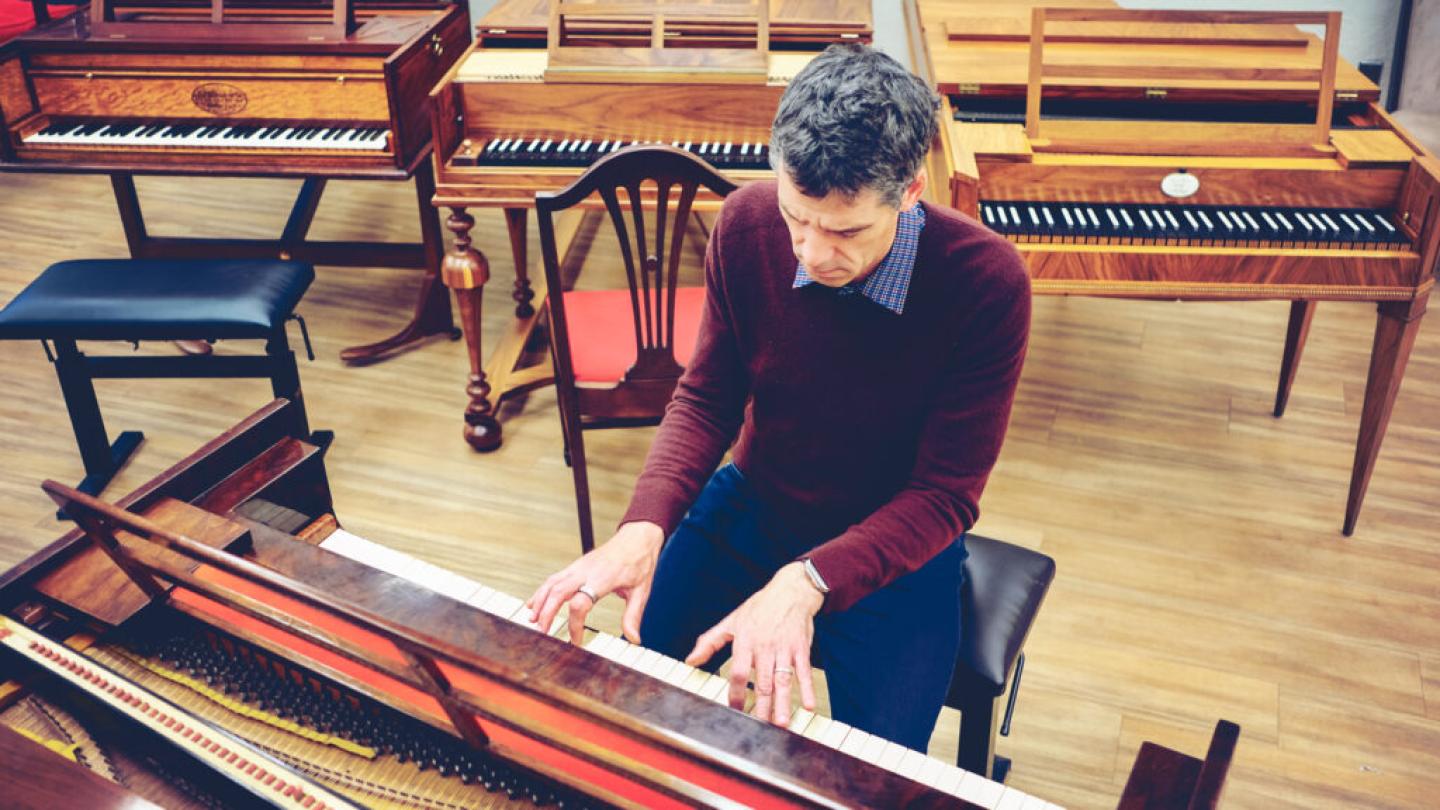
What do Sage Chapel’s massive pipe organ, a fortepiano from 1799, and a 1960s-era synthesizer have in common? In addition to their ability to produce music, they share the same interface: a keyboard.
These, and more than two dozen other keyboard-based instruments, form a selective-but-notable collection: the Cornell Center for Historical Keyboards, one of the world’s most significant resources of performance-ready historical pianos, harpsichords, clavichords, and organs.
The center’s collection includes both original instruments and historically accurate replicas that run the gamut of keyboard history. Among its core holdings are fortepianos that emeritus professor Malcolm Bilson, a giant in the field of the period instruments, gifted to the University from his own collection.
It also houses some much more contemporary items: it recently acquired four synthesizers, including two original instruments designed by Robert Moog, PhD ’65, a pioneer in electronic music.
Founded in 2019, the center has a physical home on the ground floor of 726 University Avenue.
Read the full story in Cornellians.
More News from A&S
Cornell biologist named Blavatnik Award finalist for work with rewilded mice
Neurobiology and behavior
Cornell mathematicians win grants to ensure AI safety, research integrity
Mathematics
Jazz master Chucho Valdés birthday celebration opens concert series Oct. 23
Music