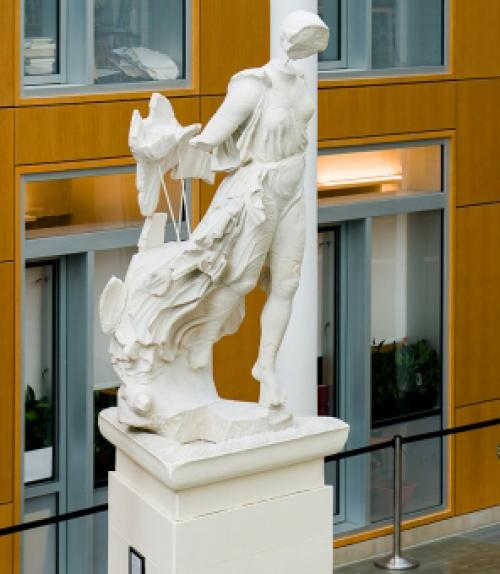
In Pliny the Elder’s encyclopedic Natural History, written in the first century AD, he recounts the story of a painter, Protogenes. Attempting to capture the foam around a dog’s mouth, Protogenes became so frustrated that he threw a sponge at the canvas. The resulting impression created just the look he had wanted.
“For Pliny,” says Verity J. Platt, associate professor of classics, “it becomes this wonderful archetype of how nature is herself an artist. The human artist is the unwitting agent of nature, grappling with raw materials, and also shaped by their properties and affordances. Pliny uses this to convey the material nature of painting and the complex relationship between nature and culture.”
To continue reading, visit the Cornell Research website.
More News from A&S



Astronomer Jonathan Lunine invested in American Academy of Sciences and Letters
Astronomy