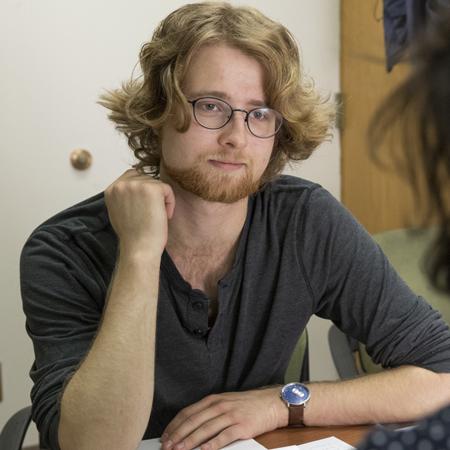
Anna Haskins, assistant professor of sociology, explores how having a father in prison affects children's schooling in this podcast on Inside Higher Ed.
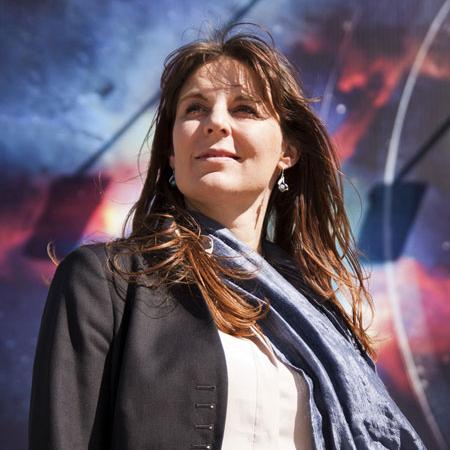
Lisa Kaltenegger, associate professor of astronomy and director of Cornell’s Carl Sagan Institute, is featured in the new IMAX film, “The Search for Life in Space,” now released internationally.
Richard Miller, the Hutchinson Professor in Ethics and Public Life in the Sage School of Philosophy, writes in this Washington Post op-ed that understanding the philosophy of libertarianism provides a basis for abandoning libertarianism.
Paul McEuen, John A. Newman Professor of Physical Science in the College of Arts and Sciences Department of Physics, has been named a Citation Laureate for his seminal contributions to carbon-based electronics.
Mark Sarvary wanted to create an opportunity for Cornell undergraduates to start building a mindset for communicating their scientific work to nonscientist audiences: funders, employers and colleagues in other disciplines.
Wealth and income disparities present problems everywhere, but they are especially acute in Africa, where 330 million people survive on less than $1.25 a day.
Julia Adolphe ‘10 is one of 19 recipients of the 2017 ASCAP Foundation Morton Gould Young Composer Awards. The awards are given to concert music composers up to 30 years of age whose works are selected through a national competition.
Scholars are using websites, vlogs, information comics and PechaKuchas to reach wider audiences than journal articles that sometimes baffle the general public.
Recent changes in the provost’s office have set the stage for better implementation of technology and teaching initiatives, blending them behind the scenes in a way that matches, and enhances, how they complement each other throughout Cornell.
In an effort to settle the debate about the origin of dog domestication, a technique that uses 3-D scans of fossils is helping researchers determine the difference between dogs and wolves.
Like human social behavior, the behavior of electrons in relation to each other is difficult to predict. In strongly correlated systems, each electron impacts how those around it act, their orientation and movement, and this leads to diverse behavior in the whole. This Cornell Research story explores this behavior.
Nima Arkani-Hamed is one of the leading particle physicists in the world. On September 25, he will be presenting the lecture, “Three cheers for ‘Shut up and Calculate!’ in fundamental physics,” in his last public talk as an A.D. White Professor-at-Large. The talk, at 7:30 p.m. in Cornell’s Schwartz Auditorium, Rockefeller Hall, is free and open to the public. There will be a pre-lecture reception held outside of Schwartz Auditorium from 6:30-7:30pm.