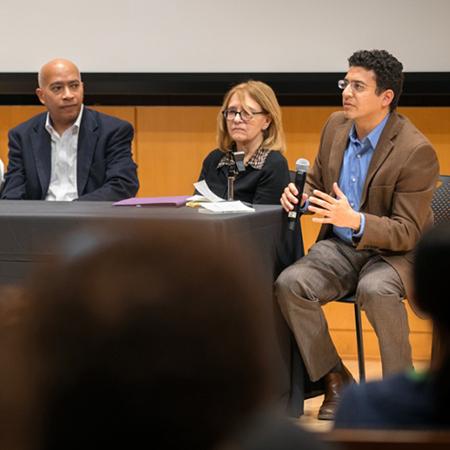
In 1989, W.E. Moerner—a Cornell University graduate and current professor at Stanford University—discovered a method that allowed researchers to see single molecules for the first time. It was a breakthrough that opened doors for the development of an entirely new technique that would impact scientific research across disciplines, and one that earned Moerner, as well as fellow Cornell alumnus Eric Betzig (Howard Hughes Medical Institute), a Nobel Prize in 2014.
J. Ellen Gainor, professor and director of undergraduate professor in Cornell’s Department of Performing and Media Arts, has won the Ellen Stewart Award for Career Achievement in Academic Theatre. The Association for Theatre in Higher Education (ATHE) presented the award at a ceremony in Las Vegas on August 3.
Slavery in West Africa has an ancient lineage dating to biblical times. Sandra Greene’s new book, “Slave Owners of West Africa: Decision Making in the Age of Abolition,” explores the lives of three prominent West African slave owners during the age of abolition in the 19th century.
o honor Cassini’s achievements and Cornell’s research role, the Department of Astronomy will hold a community farewell celebration Sept. 15 in 105 Space Sciences Building.
Sarah Kreps, associate professor of government, writes in this Washington Post op-ed that U.S. drone strikes raise legal questions about international and domestic law, and suggests without Congressional intervention, the “drone war on terrorism may become a war without end”.
The National Science Foundation awarded Cornell $9 million over five years to establish a neurotechnology hub, dedicated to developing new technologies for imagine the brain, then disseminating them to the wider neuroscience community.
Russell Rickford, associate professor of history, was awarded the 2016 Hooks National Book award for his book “We Are an African People: Independent Education, Black Power, and the Radical Imagination.”
Cornell University President Martha E. Pollack sent the following letter to President Donald Trump Aug. 31 to express her “deepest concerns” about Trump’s plans to end the Deferred Action for Childhood Arrivals (DACA) program.