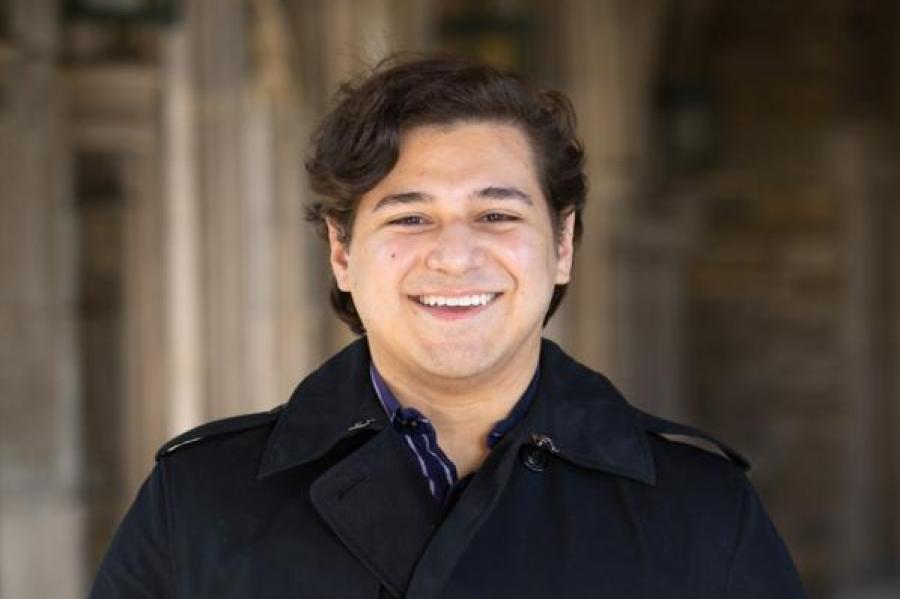
During March 29 testimon, Jamila Michener told the Committee on Oversight and Reforms that health care for marginalized communities would allow them to participate more in politics.
A team from Literatures in English and partner organizations is creating an inclusive, welcoming, anti-racist youth media network thanks to a grant from the David M. Einhorn Center for Community Engagement.
“Gayageum, Meet Violin” is a recital and discussion, set for April 16, featuring a preview performance of a new composition “Apba Hagoo, Nah Hagoo” by Ariana Kim for the Korean traditional zither (gayageum) and violin.
J.J. Zanazzi, Ph.D. ’18, has been selected for a 2022 51 Pegasi b Fellowship, which provides exceptional postdoctoral scientists with the opportunity to conduct theoretical, observational, and experimental research in planetary astronomy.
Christopher Parzyck/Provided
An artist’s conception of the single-crystal alkali antimonides photocathode, which is 10 times more efficient than existing photocathodes.
Researchers at Cornell’s Center for Bright Beams, have developed a technique to create a photocathode – a material vital to the performance of some of the world’s most powerful particle accelerators – from a single-crystal alkali antimonides.
Issued by the Provost’s Office of Faculty Development and Diversity and the Cornell LGBT Resource Center, the LGBTQ+ Resource Guide for Faculty and Staff offers best practices, including using gender-inclusive greetings in meetings and classrooms, integrating LGBTQ issues into curricula and hiring and more.
Four doctoral students studying fields in the College of Arts & Sciences are the inaugural recipients of the Zhu Family Graduate Fellowships in the Humanities.
April elections in Hungary and France will be affected by the war in Ukraine, says comparative sociologist Mabel Berezin – even as war news draws public attention from them.
Junpeng Lai/Binghamton University
An orb-weaver spider perched in the hub of its wheel-shaped web. The “claw” at the tip of each leg is “hooked” gently onto strategically placed strands of web silk and positioned to “listen” to the miniscule vibrations induced by sound waves that pass through the web.
A study of orb weaver spiders finds their massive webs act as auditory arrays that capture sounds, possibly giving spiders advanced warning of incoming prey or predators.