Professors Glenn Altschuler, PhD ’76, and Stuart Blumin take a deep dive into the borough once known as the "city of churches."

Provided
The Greek island of Santorini, traditionally known as Thera, experienced one of the largest volcanic eruptions in the Holocene epoch, most likely between 1609 and 1560 BCE, according to a new analysis
Sturt Manning has zeroed in on a much narrower range of dates, approximately 1609–1560 BCE, for the eruption on Santorini, a pivotal event in the prehistory of the region.
… to sing should be in touch with our manager, Max Yap . ’26. We were not able to welcome people from outside of Cornell last season, but the time has come for the community to return.” The Chorale is a mixed voice … the Chorale will be singing Haydn’s Lord Nelson Mass for its major concert on December 6th, a particularly timely …
Noël Heaney/Cornell University
Cornell researchers installed electronic “brains” on solar-powered robots that are 100 to 250 micrometers in size, so the tiny bots can walk autonomously without being externally controlled.
Financial aid didn’t just open a door to education for Adam Shelepak ’17—it afforded the possibility of service to the Cornell community, like founding the nonprofit Anabel’s Grocery.
This year’s anniversary of Philippine martial law is momentous, says professor Christine Bacareza Balance.
NASA/Provided
The famed Barringer Meteor Crater in the desert in northern Arizona. Two students affiliated with the Cornell Jeb E. Brooks School of Public Policy's Tech Policy Institute will analyze public opinion on how governments should respond when asteroids and comets threaten the earth.
The researchers will conduct public opinion surveys on how governments respond when asteroids and comets threaten cities, countries, or at the extreme, even the entire earth.
Lindsay France/Cornell University
During an April 2021 clinic, Cornell community members receive COVID-19 vaccines in Bartels Hall.
Six Cornell faculty members from three different colleges will work together to improve epidemiological models of infectious disease using a $1 million grant from the National Science Foundation.
Chris Kitchen
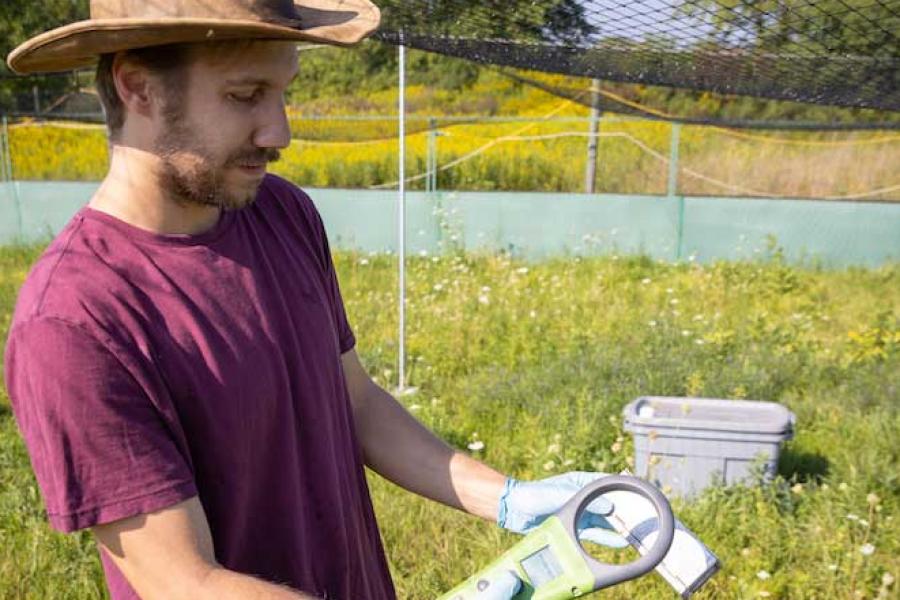
Matthew Zipple uses an RFID scanner to identify a mouse living in an outdoor enclosure. By briefly catching and releasing the mice Zipple and colleagues are able to take repeated measures of animal's body mass as they develop.