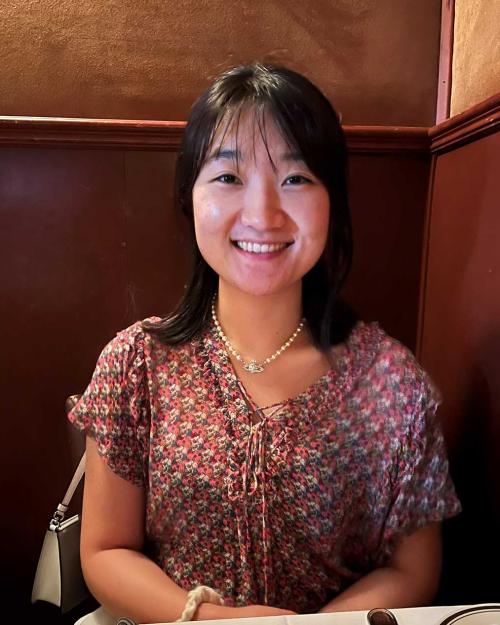
Bonnie Teece
Assistant Professor, Astronomy
Academic focus:
Astrobiology and planetary science. I like to look at chemical fossils and other hydrocarbons and their interactions with minerals, and how they are degraded by different planetary processes. I am interested in the abiotic background, mission architectures, robustness of biosignature interpretations, hydrothermal processes, distinguishing extinct and extant life, sample return and organic contamination.
Current research project:
I am currently working on projects about life detection on Mars and icy ocean worlds like Europa and Enceladus. I am also looking at the chemistry of asteroids, chondrites and other abiotic planetary bodies in our solar system to understand the abiotic background.
Previous positions:
Postdoctoral Fellow, Planetary Science Division, NASA Jet Propulsion Laboratory, 2022-2025
Academic background:
Ph.D., Geology, University of New South Wales, Sydney, Australia, 2022
Master of Research, Earth and Planetary Sciences, Macquarie University, Australia, 2017
Bachelor of Arts with the Degree of Bachelor of Science, Russian Studies, English Literature, Museum Studies, Macquarie University, Australia, 2016
Special Tertiary Entrance Program, Wollongong College, Australia, 2011
Last book read:
Non-fiction: “Upheaval: How Nations Cope with Crisis and Change” by Jared Diamond. The book follows seven different nations in times of crises and applies a framework of personal crisis resolution to the nations to explore what works and doesn’t work.
Fiction: “The Great Hunt” by Robert Jordan. The second book in the famous Wheel of Time series, it’s a high fantasy series about time, reincarnation, responsibility, power, choice and community. I really love reading fantasy books because the genre allows for deep explorations of morality and ethics.
In your own time/when not working:
I like to hang out with my dog, play video games, read, watch reality TV, do yoga, try different craft beer and go walk on lots of the beautiful trails around Ithaca.
Courses you’re most looking forward to teaching:
I am really excited to teach Astro1102: Our Solar System. It’s a course that has been taught by many storied planetary scientists from Cornell over the years, including Carl Sagan and Steve Squyres. This course is a non-major course, and I love teaching planetary to non-majors; a course for non-majors once changed my life and career direction. In the future, I am looking forward to developing an upper-level astrobiology course about the science behind why it’s so hard to definitively find life elsewhere.
What most excites you about Cornell:
I really like how everyone here is curious, even about things outside of their research interests. I am also excited to be in a place that has such deep history in my field and for me personally. When I decided to become an astrobiologist the first thing I did was read all of Carl Sagan’s books and watch “Cosmos.” Frank Drake’s Drake equation was such a seminal concept to me when I first began learning about the search for life that I got the equation tattooed on my arm. And Steve Squyres was the PI of the Mars Exploration Rovers, and I spent my Ph.D. working on a project based on the discovery of hydrated silica at Columbia Hills by the Spirit Rover and the implications for life detection. So, to walk these halls and be a part of the department where all the science happened is really something special to me.
More News from A&S