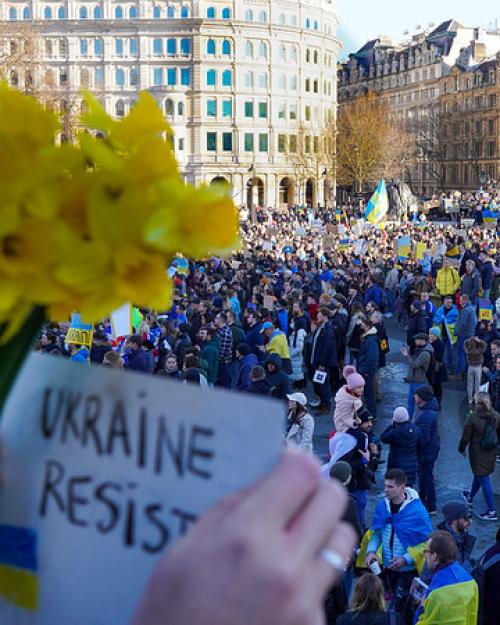
On the fourth anniversary of Russia’s full-scale invasion of Ukraine, President Volodymyr Zelenskyy says Russia has failed to achieve its “war goals.” During a recent visit to Kyiv, European leaders have vowed to “stand firm” with Ukraine.
David Silbey, a professor at Cornell University who specializes in military history and defense policy, says what’s notable is the lack of change in the last year.
Silbey says: “The war’s settled into an essentially static front line from the north to the south, looking like nothing so much as a World War I trench system. Like World War I, sticking your head out of the trenches can get you killed rapidly. In WWI, it was machine guns and artillery fire. Here it’s that, plus drones. The effect is the same, though, with troops burrowing underground and putting together whatever improvised defenses they can.
“The Russians are still winning the war, in the bare sense that they hold the eastern provinces of Ukraine and are advancing, if slowly and at extortionate cost. I don’t see popular will on either side breaking any time soon. For Ukrainians, this is perceived as an existential war. For Russians, there is still fairly broad support for the war, and Putin’s intelligence apparatus keeps dissent pretty well squashed. Given that, I’m thinking that this will remain stagnant for a while to come.”
More News from A&S


Annetta Alexandridis commemorated through installation, Oct. 31 memorial
History of Art and Visual Studies
Shakespeare’s 'Twelfth Night:' Mad Love, Mad Music
Performing and Media Arts