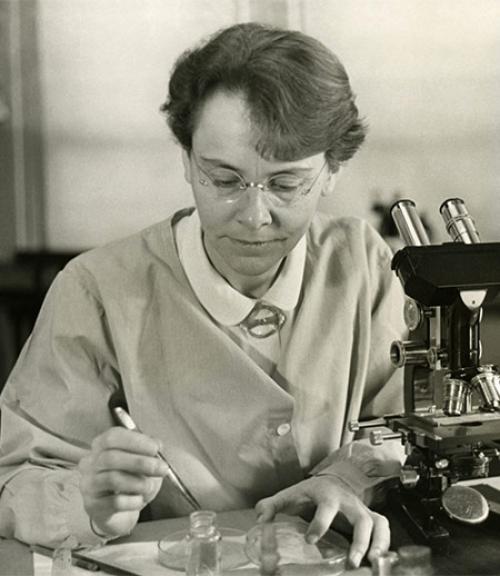
Margaret Rossiter, the Marie Underhill Noll Professor of History of Science Emerita and graduate school professor, was recently featured in Smithsonian Magazine discussing her 2012 book, "Women Scientists in America: Forging a New World Since 1972."
In the interview, she discusses her firsthand experience of a lack of women's representation in science. Since then, she has dedicated years of academic research to analyzing the systemic discouragement women face when expressing an interest in science.
“It is important to note early that women’s historically subordinate ‘place,’ in science (and thus their invisibility to even experienced historians of science) was not a coincidence and was not due to any lack of merit on their part,” Rossiter wrote at the outset in the first volume. “It was due to the camouflage intentionally placed over their presence in science.”
Chris Kitchen/College of Arts and Sciences
Using a new technique, Paul Malinowski and other researchers in Kyle Shen’s lab found that iron selenide’s superconducting “dome” is more closely linked to resistance caused by imperfections in its crystal lattice than to the number of electrons flowing through the crystal.