Jonathan Gomez Barrientos ’22 was first drawn to astronomy by Curiosity, the Mars rover that the National Aeronautics and Space Administration (NASA) launched in 2011. He wanted to learn more about the instruments on board the rover. While taking introductory astronomy classes during his first two years at Cornell, he found that he was passionate about astronomy and all it had to offer.
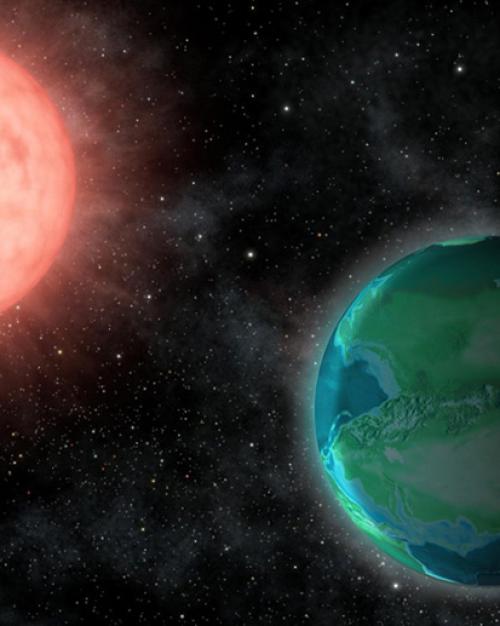
Barrientos now explores the possibility of life on Earth-like planets beyond our solar system, called exoplanets, under the direction of Lisa Kaltenegger, associate professor of astronomy and director of Cornell’s interdisciplinary Carl Sagan Institute.
“By Earth-like exoplanets we really mean rocky exoplanets that orbit in this region called the habitable zone, which is a region in space where the conditions are just right for liquid water to potentially exist on the surface of the exoplanet,” explains Barrientos. Although current technology cannot find life on exoplanets, the recently launched James Webb Space Telescope (JWST) will for the first time be able to search for biosignatures—such as the presence of oxygen in combination with a reducing gas like methane—that might indicate life on other worlds.