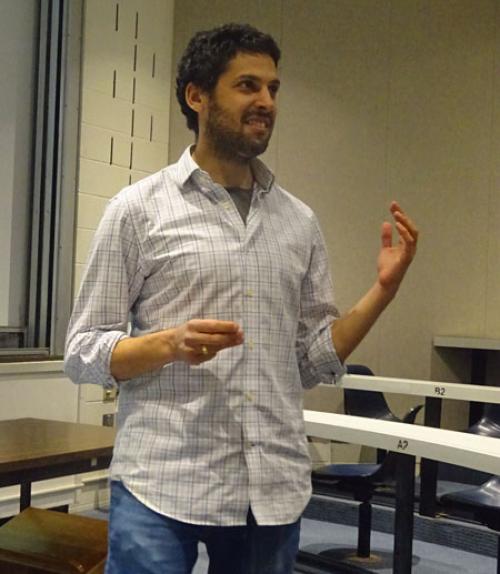
Math matters in important ways, and each year Cornell’s Department of Mathematics sponsors a public lecture to illustrate just how much. This lecture takes place during the national Mathematics Awareness Month, with the goal of increasing public understanding of and appreciation for mathematics. This year’s lecture, held April 29 in Malott Hall, featured assistant math professor Lionel Levine on “The Future of Prediction.”
Levine shared his experiences in a prediction tournament with thousands of players and discussed the uses (and abuses) of math in predicting the future. He challenged the audience to predict the next term in this sequence: 0, 1, 3, 4, 9, 10, 12, 13, 27, 28, 30, 31 and demonstrated how randomness can be more predictable than usually thought.
After the talk, the audience joined Levine for pizza and conversation about math, predictions, and the future of pi, sponsored by the Math Club.
A video of Levine’s talk is posted on the math department website.
More News from A&S


CTI announces 2026 winners of Ye Awards for graduate achievements in teaching
Neurobiology and behavior